The book of Matthew—and thus, the New Testament—begins with the remarkable genealogy of Jesus. Genealogies make tough reading, but put yourself in the writer’s position:
Matthew wants to prove to his Hebrew people that Jesus is their long-awaited Messiah. Jesus’s ancestry is the logical place to start.
“The historical record of Jesus Christ, the Son of David, the Son of Abraham” Matthew 1:1.
Matthew begins with the biggest news in the history of Israel: he calls Jesus the Messiah, God’s Anointed One, a phrase rendered as Christ in Greek. Not only that, Matthew calls his book a “historical record.” That’s important:
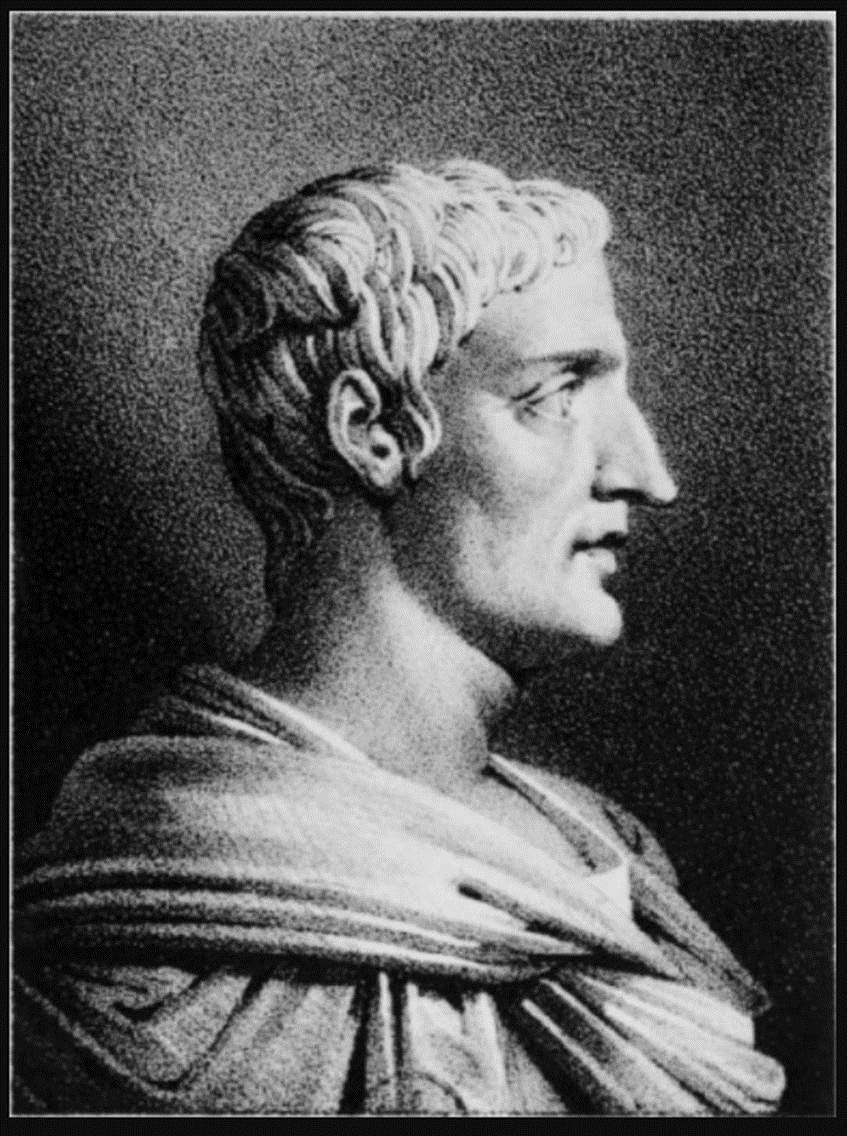
Jesus Christ is part of history. He is not some mythological figure. In fact, non-Christian historians wrote about him, including the Jewish historian Josephus and the Roman historian and senator Tacitus (pictured). Both report that Jesus was crucified by Pilate.
Next, Matthew records the written genealogy of Jesus, including 46 generations from Abraham to Jesus, and concluding with another astounding Bible verse:
“So all the generations from Abraham to David were 14 generations; and from David to the exile to Babylon, 14 generations; and from the exile to Babylon until the Messiah, 14 generations” Matthew 1:17.
Because seven is a perfect number, three successions of fourteen is particularly special. The poetry of this sentence has always appealed to me, but I have wrestled with this tricky genealogy for many years. Like I said, there are only 46 links in this chain. Mathematically, 14 x 3 = 48. Every year, I would find myself reading and re-reading this chapter, struggling to understand Matthew’s arithmetic.
For a few years, I had decided that the Joseph listed as the “husband” of Mary should be listed as the “father” of Mary. That would add a generation. However, not one of the 60-plus English translations available on BibleGateway(dot)com translates that word as father. Not even one! So this morning, I scratched out the note I had written in my Bible. Then I re-read and re-counted. Again, things did not add up. But I kept at it. I knew there had to be an answer.
Then suddenly, I solved this mystery!
Matthew counts two people twice. The count proceeds this way: (1) Abraham to David, 14 generations; (2) David to Josiah (Babylonian exile), 14 generations; and (3) Josiah to Jesus, 14 generations. So from Abraham to David is a neat 14, from David through Josiah is another 14, and from Josiah to Jesus is a final 14. This count requires you to count David and Josiah twice, but that fits the language of verse 17: three groups of 14. For years, I have been counting generations and struggling to figure this out! Today, I finally did. Now, here’s a question for you:
Have you ever pulled out a calculator to figure out the Bible? Have you ever grabbed scratch paper so you could make sense of a difficult passage? Have you ever researched what commentators (preachers and professors) have to say about a scripture?
If not, why not? Don’t just half-read, hoping something you see will make you feel warm inside. READ WITH YOUR MIND. Think hard! Study! DIG!
“Work hard so God can say to you, ‘Well done.’ Be a good workman, one who does not need to be ashamed when God examines your work. Know what His word says and means” 2 Timothy 2:15 (TLB).
ΑΩ
- Some commentators add that there are Old Testament records of additional links in the chain. That is, Jesus may have another generation or two of ancestors that Matthew does not record. These writers believe Matthew’s audience would have known about those generations, and understood Matthew’s purpose: to demonstrate that the Messiah was an heir of both Abraham and David, and they would not have been troubled by alleged omissions. My uninformed hypothesis is that Matthew may have had reason to doubt some of the entries in those other records, thus rendering the 46 generations recorded here the most accurate statement of the ancestry of Jesus.
- In another devotional, I analyzed the ancestors of Jesus. Guess how many generations there are from Adam to Jesus? Seventy-seven, by my count (based on Luke 3). Full disclosure–some parties online agree with me, some do not. Either way, it is an interesting number.
 Household Words: