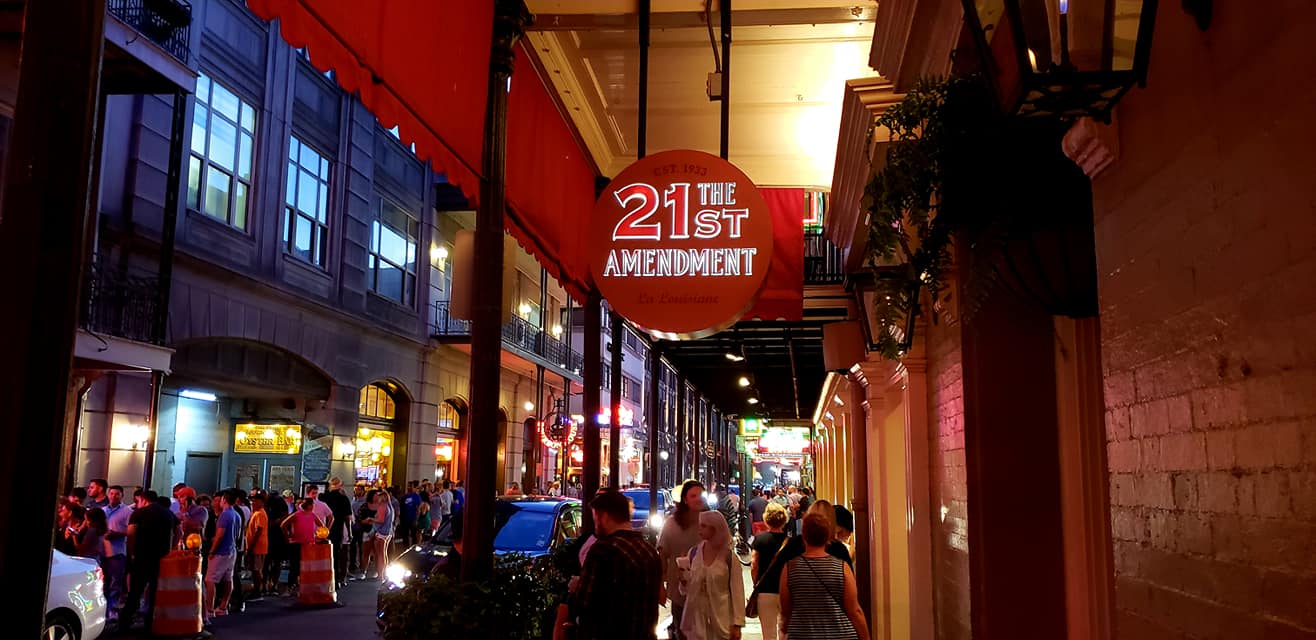
Pictured–the “21st Amendment,” a bar in New Orleans’ French Quarter celebrating a unique bit of legislation. I did not go inside.
Have you ever eaten meat from an animal that was sacrificed to an idol? Probably not. Have you ever been seen “dining in an idol’s temple” (1 Corinthians 8:10)? Doubtful. In fact, the entire conversation must seem hopelessly irrelevant to 21st-century life in the USA. But it is quite relevant, which we will come to. But first, consider Paul’s argument. He explains that idols are nothing, thus, in grace, we have the freedom to eat meat dedicated to idols with a clean conscience. But we must exercise such freedom with caution. Why? Because some with a “weaker conscience” might not understand.
“Not everyone has [our understanding of freedom]. In fact, some have been so used to idolatry up until now that when they eat food offered to an idol, their conscience, being weak, is defiled…. We are not inferior if we don’t eat, we are not better if we do eat. But be careful that this right of yours in no way becomes a stumbling block to the weak. For if someone sees you, the one who has [this freedom in the grace of Christ], dining in an idol’s temple, won’t his weak conscience be encouraged to eat food offered to idols? Then the weak person, the brother for whom Christ died, is ruined by your freedom. Now when you sin like this against the brothers and wound their weak conscience, you are sinning against Christ. Therefore, if food causes my brother to fall, I will never again eat meat, so that I won’t cause my brother to fall” 1 Corinthians 8:7-13.
So why is the meat-sacrificed-to-idols conversation relevant to life today? ALCOHOL.
Christians enjoy freedom in Christ. Paul writes “all things are lawful for me” 1 Corinthians 6:12. We have the freedom to consume alcohol. Jesus created wine out of water at the wedding at Cana, John 2:1-11. Jesus also consumed alcohol and fed it to His disciples at the Last Supper. Moreover, He promised to drink wine again in heaven Matthew 26:29.
Nevertheless, the United States has a complicated history with alcohol. In response to some very real problems created by the abuse of alcohol, the temperance movement saw the passage of two Constitutional Amendments: in 1919, the 18th Amendment made the manufacture, transportation, and sale of liquor a crime. In 1933, the 21st Amendment repealed the 18th Amendment. The story is complicated, but it is worth noting that many Christian churches and even entire denominations took sides in the Prohibition battle. Those historic positions continue to have influence.
What does it mean for today? It means that Christians must exercise their freedom with love and consideration for the conscience of their brothers.
If you teach at a Christian school or volunteer to work with youth at your church, be careful about wounding the conscience of children who may have been raised to believe drinking is wrong. You can argue the Bible gives a more “nuanced” message on the subject. But children and young believers often cannot grasp nuance.
We have freedom in Christ. But more importantly, we must exercise our freedom with wisdom. We must not cause young Christians or new believers to stumble. Look again at how Paul concludes his words:
“Therefore, if food causes my brother to stumble, I will never again eat meat, so that I won’t cause my brother to stumble” 1 Corinthians 8:13.
Enjoy your freedom in Christ. But remember that self-restraint and love for your weaker brother are more important.
ΑΩ
P.S. Drinking is a nuanced issue with plenty of gray areas and room for reasonable minds to disagree. Remember the history of Prohibition in the United States: many churches and denominations took rigid positions on one side or the other–and those positions tend to persist a century after Prohibition was repealed. My conclusion is: Jesus drank wine and miraculously provided it to others. Who am I to say it is wrong? Yet dozens of Bible passages warn of the ill effects of drinking. We must do as Paul says, “let each man have his own conviction” (Romans 14:5) and “judge not” (Matthew 7:1). Finally, If you drink often, consider fasting often. Fasting moderates appetites, ensuring we will “Be not drunk on spirits, but filled with the Holy Spirit” Ephesians 5:18. https://dadsdailydevotionals.com/2023/04/06/its-not-if-but-when/
 Household Words: