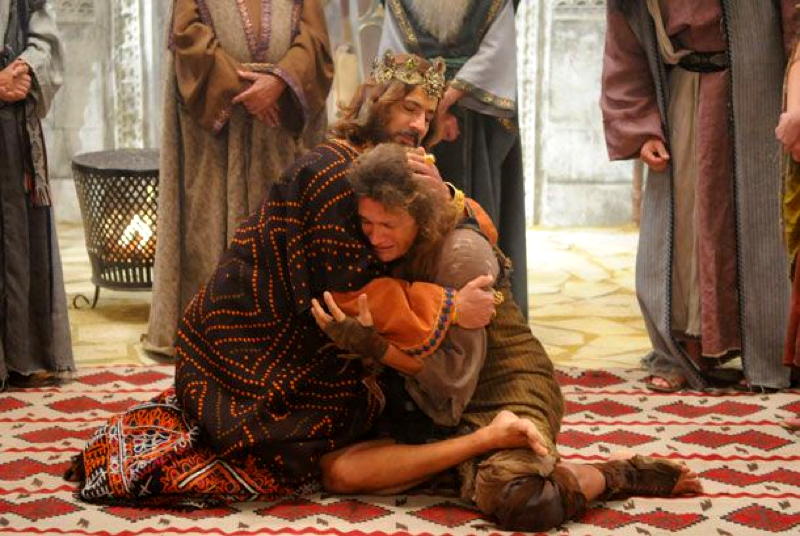
Pictured: David restores Mephibosheth, artist unknown.
A king may have a long and peaceful rule. But when the king dies, the Problem of Succession asks who will be the new king? Who will succeed to the throne?
To address this problem, the French and English began announcing one king’s death with the next king’s succession in a single sentence: “The King is Dead; Long Live the King!”*
But it was rarely that simple. The Problem of Succession could be complicated by the seemingly rightful claims of two or three persons, often brothers. One may have the popular support of the citizens, a second may have the support of the rich and powerful, while a third may have the support of the military. When such problems arose, they often resulted in murder and fratricide: one brother would take the throne and immediately kill his other brothers to establish his reign. If his brothers have had sons, the new king may kill his nephews too. It was a bloodbath. For example, King Abimelech killed his 70 of his 71 brothers in Judges 9:5, and King Jehu killed the 70 sons of King Ahab in 2 Kings 10:11, 2 Chronicles 22:8.
King Saul’s grandson and heir Mephibosheth was born into such a world. Saul and his son Jonathan died on the same day, but Saul had a surviving son named Ish-Bosheth—who was immediately crowned king over every tribe but Judah. King Ish-Bosheth reigned in Israel two years while King David reigned only in Judah, 2 Samuel 2:10.
Then Ish-Bosheth was murdered (not by David) and David became king over the entire nation. But Saul had a surviving heir, his grandson, Mephibosheth, who was five when Saul and Jonathan were killed. Fearing for the boy’s life, his nurse had grabbed him and fled, but she dropped him, crippling him permanently. Two years later, his uncle, King Ish-Bosheth, was murdered. Mephibosheth remained in hiding for years, born a prince, now a fugitive, who no doubt feared King David would have him murdered the day he discovered one of Saul’s heirs remained alive.
A sentence of death hung over the life of Mephibosheth, leaving his heart more crippled than his feet.
Then one day, Mephibosheth was summoned to David’s royal court. This humble, broken man who probably traveled everywhere by crutches or a cart, must have been terrified. How can I possibly pose a threat to David, he may have asked himself. Who am I? No one even knows I’m alive. I don’t have an army. No one would want me for a king. I’m nothing! I’m useless! I’m a worthless wretch. A beggar. I imagine Mephibosheth did not think highly of himself.
“Now when Mephibosheth, the son of Jonathan, the son of Saul, came to David, he fell on his face and did reverence. And David said, ‘Mephibosheth.’ And he answered, ‘Behold thy servant!’ And David said unto him, ‘Fear not. For I will surely show thee kindness for Jonathan thy father’s sake, and will restore to thee all the lands of Saul your father. And thou shalt eat bread at my table continually.’ And Mephibosheth bowed himself and said, ‘What is thy servant, that thou should look upon such a dead dog as I am?’” 2 Samuel 9:6-8.
But there was more. Not only did David give all of Saul’s lands to Mephibosheth. Not only did he grant him a permanent seat at his royal table, a prince once again. But David also commanded Saul’s servants to work for Mephibosheth. That was Ziba and his fifteen sons and his twenty servants—King David instructed the 36-man crew to farm Mephibosheth’s lands and bring the produce to him.
David took a broken, crippled man, a fugitive who lived his entire life in the shadows of shame and under risk of death, and elevated him to one of his most honored men. David gave Mephibosheth the honors he had hoped to give to Mephibosheth’s father, Jonathan.
And this is our life. We were born into such a world. We were born into a world of guilt and shame, hiding in the shadows, a sentence of death pronounced over our lives, but Jesus sought us out.
Like David in 2 Samuel 9:1, Jesus asks “Is there anyone left that I can honor?” And Jesus found you. And Jesus found me. And he offers forgiveness. A clean slate. He gives us grace. Restoration. He takes off our rags and clothes us with his righteousness. He gives us blessings, gifts, property, goods, and a seat at his table. And he calls you friend, John 15:15.
As Cory Asbury sings, “Check your shame at the door, ‘cause it ain’t welcome anymore. You’re in the Father’s house.”
Mephibosheth had to drop his load of shame when he entered David’s house. Have you dropped your shame? Have you given your sin, guilt, and brokenness to Christ? Do you truly know that “there is therefore, now NO CONDEMNATION” in your life? (Romans 8:1).
God, restore our lives as David restored the life of Mephibosheth. Show us how to lean on you for forgiveness, grace, restoration, hope, and joy. Make us instruments of your restoration. May we do for others what King David did for Mephibosheth.
ΑΩ
* Not to be confused with “God Save the King,” the national anthem of Canada, New Zealand, and the unofficial anthem of Great Britain, and a direct quote from 2 Samuel 16:16– “And it came to pass, when Hushai the Archite, David’s friend, was come unto Absalom, that Hushai said unto Absalom, ‘God save the king, God save the king.'”
 Household Words: