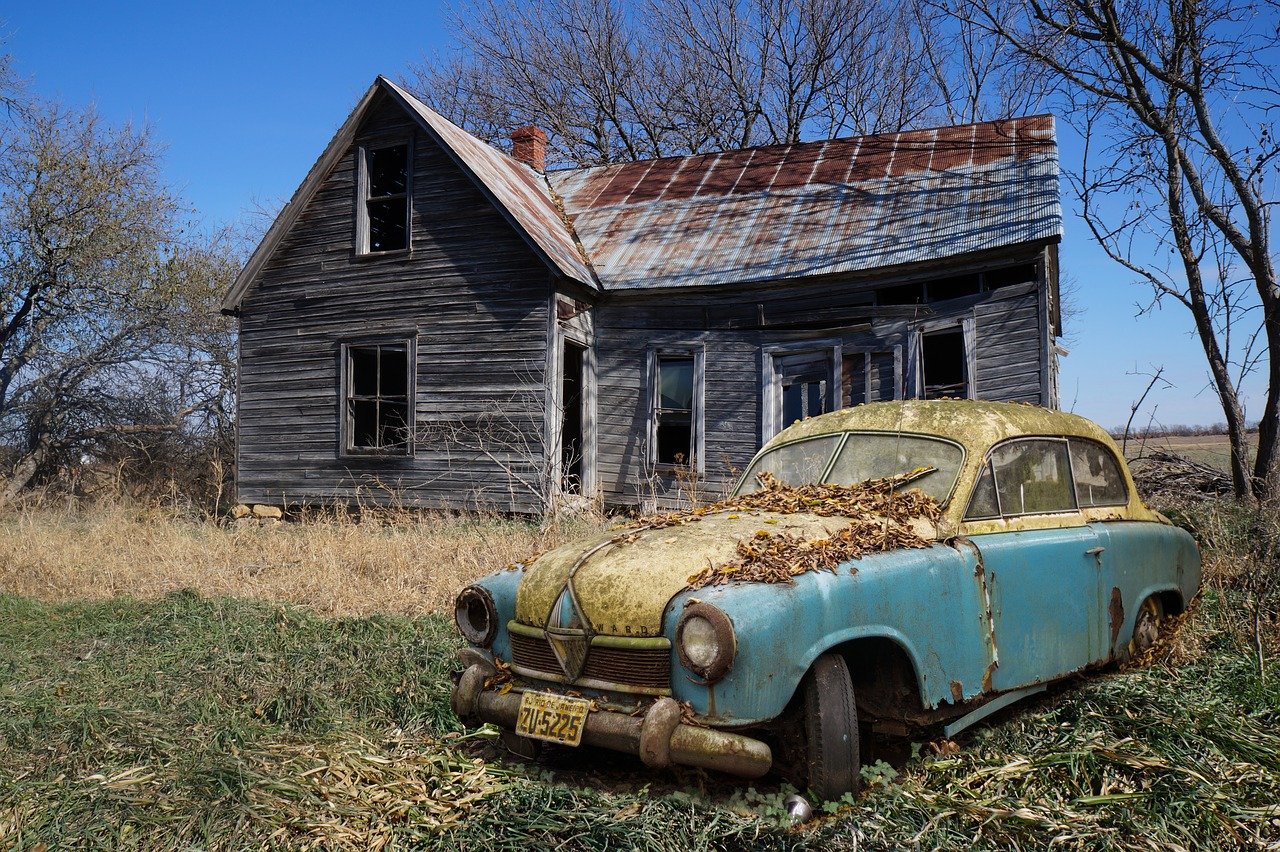
My Uncle Bob’s farm had the most perfect house set on a hill. The house was always filled with happy voices and laughter and the smells of a wood fire in the fireplace and something delicious in the kitchen. The view from the front porch was the most peaceful thing I have ever seen.
But hidden in some trees down by the barn was an abandoned old house that my cousins and I would explore. The boards on the porch were loose; you just knew you were about to fall through. Inside the house there was junk everywhere: old torn childrens’ books, broken toys, trash, empty hangers, rusty odds and ends. The kitchen cabinets were empty. I remember a toilet with a dead rat in it—the biggest rat I’d ever seen. The roof was leaking, wallpaper peeling, mold creeping. Windows broken. Doors stood open. Vermin and varmints came and went: termites, roaches, rats, worse. The last time I saw that house it had sunk into its own collapse like a cardboard box in the rain. The forest was growing up through it, swallowing it.
King Ahaz may have been the worst of all the kings in Israel and Judah. Though many of the Hebrew kings tolerated or even encouraged idol worship, only King Ahaz looted Solomon’s temple, then closed and locked its doors.
“And Ahaz gathered together the vessels of the house of God, and cut in pieces the vessels of the house of God, and shut up the doors of the house of the Lord, and he made him altars in every corner of Jerusalem” 2 Chronicles 28:24.
Throughout Ahaz’s 16-year reign the temple remained closed, and the temple courts became a junkyard.
Even a gold-plated temple will fall into disrepair when abandoned. But worse than that, imagine the spiritual life of Jerusalem! God had given his people the priesthood, the sacrifices, the law of Moses—everything they needed to worship him, but the idol-worshipping King Ahaz took it away. Then King Ahaz died and his son, Hezekiah became king in his place.
With a king as bad as Ahaz, it would seem that giving his son the crown would only perpetuate the problem. But in fact, Hezekiah was a good king, choosing to follow the examples of his grandfather and great-grandfather rather than his father.
King Hezekiah gathered the priests and the Levites and instructed them to clean and restore the temple and its courts.
“It is in mine heart to make a covenant with the Lord God of Israel, that his fierce wrath may turn away from us” 2 Chronicles 29:10.
The passage then names 14 men chosen to lead teams of men doing the cleaning. Somewhere between 50 and 150 men must have helped clean the temple and its courts.Yet, the job still took them more than two weeks.
“And they gathered their brethren and they sanctified themselves, and they came … to cleanse the house of the Lord. And the priests went into the inner part of the house of the Lord, to cleanse it, and brought out all the uncleanness that they found in the temple of the Lord into the court of the house of the Lord” 2 Chronicles 29:15-16.
After sixteen days the Levites had cleansed and sanctified the temple and the temple courts. Soon Hezekiah rededicated the temple by sacrificing thousands of sheep and cattle, then he led the nation to celebrate Passover for the first time since the reign of King Solomon, some 200 years before, 2 Chronicles 30:26.
Hezekiah observed under his father’s leadership the crumbling state not only of the temple, but of the spiritual life of the nation, and he became a great reformer. In spite of the failures of the man who raised him, King Hezekiah brought repentance and revival to the nation and was one of the greatest kings in Judah’s history.
Dear God, may we rise above the limitations of our parents! Challenge us to do better and go further than our parents may have. Call us to a deeper relationship with you, to a deeper faith and a deeper devotion. Use us to bring hope, grace, and truth to those around us. May we abide in the vine and bear much fruit! John 15:5.
AΩ
 Household Words: