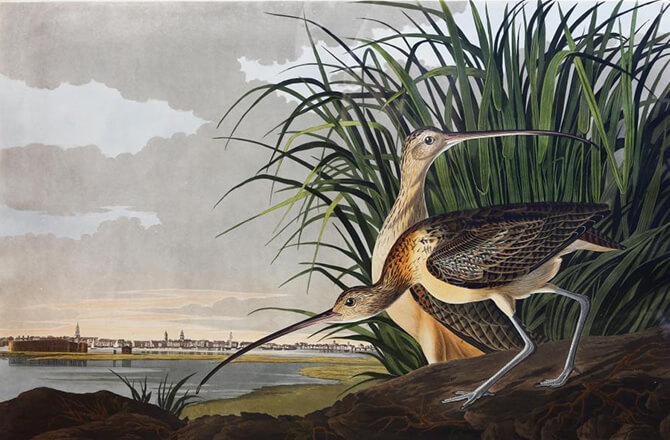
Image: Long-Billed Curlew, by John James Audubon, one of 435 life-sized, realistic watercolor paintings in his BIRDS OF AMERICA, 1838, a staggering masterpiece of documentation.
A naturalist is a kind of hybrid scientist-reporter-artist-categorizer, such as John James Audubon, John Muir, and Jane Goodall. They publish their findings in books with simple titles like THE RED SQUIRREL, ITS LIFE, HISTORY, AND HABITS, by Robert Hatt.
Imagine if a naturalist went into the woods with a journal and sketch pad to write a book about idol worshippers. The working title might be: THE IDOL WORSHIPPER, HIS LIFE AND HABITS. What would the observer see if he spent a few years observing the activities of the idol worshipper? An entry in the naturalist’s journal might sound something like this (adapted from Isaiah 44):
Among the idol worshippers, I continue to observe the peculiar role of the craftsman. Unnoticed from my perch in the tree canopy, I am free to watch through binoculars as the woodcarver uses his ax to carve an idol.
He measures and marks out a pattern on a block of wood. Then he carves the figure of a man or a bird or some celestial being, a sun-god, perhaps. It seems he will make from the tree whatever his customer requires.
When he is finished, he congratulates himself. Now he has a wonderful idol that can’t so much as move from where it is located. Then the woodsman goes into the forest, cuts down cedars, selects cypress trees and oak trees. He even plants new trees to be nourished by the rain.
And after cutting down another tree, he divides the wood. With part of it he makes a fire to warm himself and bake his bread. And with the other part of the wood—from the same tree he burned for heat—he fashions for himself a god to worship.
I have drawn detailed pictures of each of these activities. The idol maker in question is a consummate woodsman, cultivating saplings, harvesting mature trees, even expertly grafting trees together to produce desired variations. And the man works the wood as only a master artisan could.
As an observer, I find it curious that the woodsman does each of these things without a hint of irony. He believes in his homemade god as strongly as does his customer. After exercising such complete power over the life, death, and end-use of the tree, he falls down to worship that which moments before he was cutting, sanding, and staining.
With part of the tree he roasts his meat and keeps himself warm and content, and with part of the tree he makes himself a god, a carved idol. He falls down before the little carving and prays to it. “Deliver me,” he says. “You are my god!”
It was clear to this observer that the man never stopped to think ‘Why, it’s just a block of wood! I’ve burned it for heat and used it to bake my bread and roast my meat. How can it be a god? Should I fall before a chunk of wood?’
The poor deluded fool. He is trusting what can never give him any help at all. Yet he cannot bring himself to ask, ‘Is this thing, this idol I am holding in my hand a lie?’ [Adapted from Isaiah 44:12-20, the Living Bible.]
In modern times it is difficult to relate to an idol worshipper. We ask, How could anyone pray to an inanimate object? But don’t be too quick to judge. We moderns worship idols too. Paul defined idol worship best when he condemned the unrighteous in Romans 1.
“Claiming to be wise, they became fools, and they exchanged the glory of the incorruptible God for an image in the form of corruptible mankind, of birds, four-footed animals, and crawling creatures. They exchanged the truth of God for a lie and worshiped and served the creature rather than the Creator, who is blessed forever. Amen” Romans 1:22-23,25.
Don’t we do these things? Don’t we know people who do these things? Do you know anyone who claims to be wise, but has become foolish? Do you know anyone who has exchanged the truth of God for a lie?
Do we worship and serve the creature—even if that creature is ourselves—rather than the Creator?
Yes. We worship idols. And it is just as obvious. Pound-for-pound, most animals are many times stronger than humans. Their bodies can survive a fall from much higher than we can. Most animals can outrun us, outfight us, and are far better equipped for life outdoors in the harsh weather. Humans are, in fact, among the weakest and most pathetic creatures walking the earth. All we have is brain power and an inborn sense of the eternal, yet we misuse the one and pervert the other.
And we walk about as though we were gods, ignoring the facts: We trip and fall over nothing. We stub our toe and lose our minds. We develop a minor illness and cannot leave the house. We are deeply vulnerable—to heat, to cold, to waterborne diseases, to small animals, to bugs, to germs so tiny we cannot see them. Yet we worship ourselves? Why?
We tell ourselves we are the masters of our fate, the captain of our ship. We pat ourselves on the back and tell ourselves we are powerful and in-control. We think we are Ozymandias, “king of kings,” yet our kingdom lies in ruins and we will soon be as forgotten as he is, our time on earth an imperceptible blip of meaninglessness.
“Only one life ‘twill soon be past. Only what’s done for Christ will last”—C.T. Studd.
God, reveal to us every idol in our lives! Fill us with a deeper love for you. May we praise you and trust you to provide and protect us in every situation. May we never elevate any person, possession, passion, or panic above you.
AΩ
 Household Words:
One thought on “Observing the Idol Worshipper in His Native Habitat. Isaiah 44:12-20.”