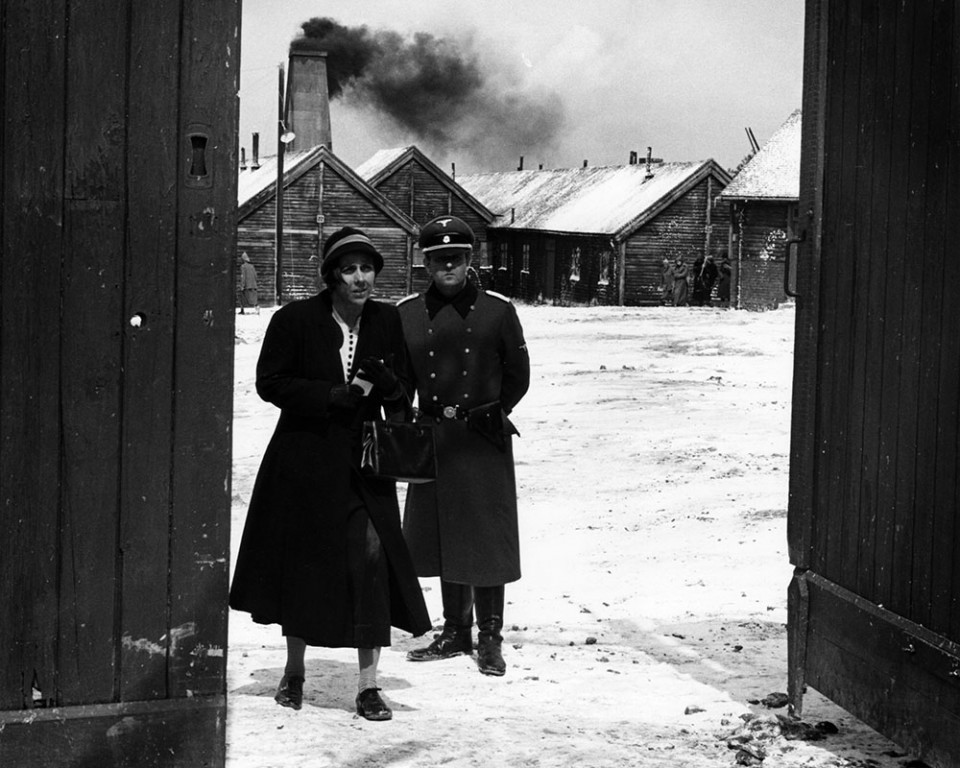
Image. Corrie Ten Boom being released from Ravensbruck Concentration Camp. (This is a still from the 1975 film the HIDING PLACE starring Jeannette Clift as Corrie Ten Boom.)
Jeremiah had reason to be scared. The pagan king Nebuchadnezzar had no regard for Jeremiah or Jeremiah’s God. The Captain of Nebuchadnezzar’s Guard “came … unto Jerusalem and he burnt the house of the Lord and the king’s house and all the houses of Jerusalem, every great man’s house burnt he with fire” 2 Kings 25:8-9.
The Captain of the Guard led the Babylonians in burning down Solomon’s Temple! Then he burned down the palace of King Zedekiah, all the houses of the best and brightest, and then began tearing down the walls of the city. The Captain of the Guard was destroying everything.
Then the Captain of the Guard went after the royal family:
“And they slew the sons of Zedekiah before his eyes, and put out the eyes of Zedekiah, and bound him with fetters of brass, and carried him to Babylon” 2 Kings 25:7.
This story is recorded three times, once in 2 Kings and twice in Jeremiah.[1] “Then the king of Babylon slew the sons of Zedekiah before his eyes … slew all the nobles of Judah … and put out Zedekiah’s eyes” Jeremiah 39:6-7.
The Babylonians were known for their cruelty, and this was no exception. They killed the sons of the king, made him watch, then immediately blinded him so the corpses of his sons would be the last things he ever saw. Then the grieving, blinded king was taken away to a Babylonian dungeon. “They carried him to Babylon and put him in prison till the day of his death” Jeremiah 52:11.
Judah’s leaders had tried to kill Jeremiah previously, throwing him into the muddy bottom of a cistern during a famine. Now he is languishing in prison, when he learns that the Captain of the Guard has arrived and wants to talk to him.
Jeremiah must have been concerned–the man who burned the palace and the temple and attacked the king and his princes has now come asking for Jeremiah.
When the Captain of the Guard comes to Jeremiah, he begins by defending Babylon’s actions, arguing Israel’s sins caused all this destruction.
“The Lord thy God pronounced this evil upon this place. Because ye have sinned and not obeyed the voice of the Lord, therefore this thing has come upon you…” Jeremiah 40:2-3.
Jeremiah must have been thinking ‘And why are you telling me this?…’ And then he got his answer:
“‘And now behold, I loose thee this day from the chains that were upon thy hand. You can come with me to Babylon or you can stay here in Jerusalem—whatever seems best to you’ … So the captain of the guard gave him food and a reward and let him go. Then went Jeremiah to Gedaliah the son of Ahikam … and dwelt with him among the people that were left in the land” Jeremiah 40:4-6.
Jeremiah was thrown in the quicksand of a cistern. Then he was abandoned in a prison. Finally, the Captain of the Guard comes to the prison. I can imagine Jeremiah thinking, ‘well, this can’t be good.’ But it was. The Captain of the Guard said a few diplomatic words, then told Jeremiah he was free to go. What an odd, anticlimactic moment that was. No angel choirs. No dramatic rescue. Just a few kind words, a sack lunch, and a handful of money, and “Okay. You’re free to go.”
This account reminds me of the release of Corrie Ten Boom at the end of her story THE HIDING PLACE. She was suffering in Ravensbruck, having watched her beloved sister die. Then one day they called her to the office and told her she was being released. Released? No one is released! From a Nazi Death Camp? Corrie Ten Boom buttoned her coat and walked out into the snow. Later her release was attributed to a clerical error.
But of course, God was behind it. Just as God protected Jeremiah’s life and saw that he too would be released. God had promised to protect Jeremiah: “‘Do not be afraid of them. For I am with you, to deliver you,’ declares the Lord” Jeremiah 1:8.
Will everyone be released? No. Some of God’s children will suffer and die, like Corrie Ten Boom’s sister, Betsy. But God’s children will never suffer alone.
“Behold, I am with you always, even to the end of the age” Matthew 28:20.
Keep the faith and have courage!
AΩ.
[1] These events are also recorded in the extra-Biblical record known as the Babylonian Chronicle ABC-5. The Babylonian Chronicles are a collection of some 45 ancient stone tablets that record the history of ancient Babylon. The tablet designated ABC-5 (the “Jerusalem Chronicle”) documents the activities of King Nebuchadnezzar and is one of the many ancient writings that confirm the historicity of the Bible.
 Household Words: