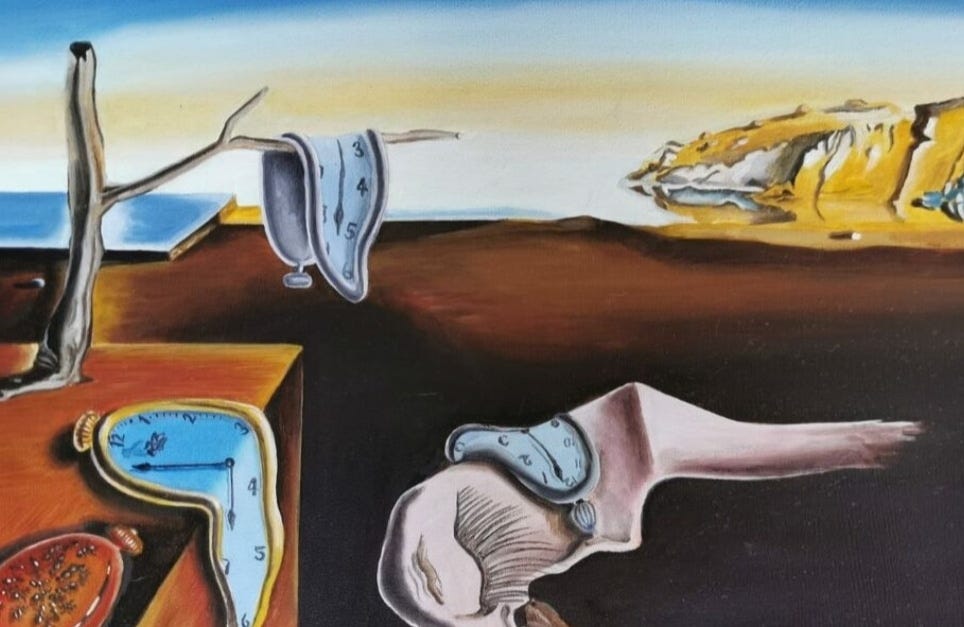
Image: The Persistence of Memory by Salvador Dali, 1931.
I attended law school at the University of Houston, a campus littered with abstract modern art, much of it consisting of odd-shaped works in iron. One day while walking across the campus with a student whom I knew to be a lover of modern poetry, we came across one of these quirky red abstractions. This one looked like a chair, if it were crafted in a Dr. Seuss book, all of it completely absurd. Daniel spoke up in his clipped, rapid-fire speech.
“I hate modern art. Despise it. Ridiculous.”
“But you love modern poetry.”
“Totally different. Poetry uses beautiful language to lament the absurdities of modern life.”
“But that’s not different at all. This sculpture laments the absurdities of modern life with three-dimensional forms instead of words. It’s making a philosophical statement. It’s the same statement as modern poetry—that life is complicated, that things are unclear and unknowable, that life is absurd. Modern art is saying the same thing as modern poetry.”
“You really believe that?”
“Yes. Except that I don’t agree with the statement. Life is not absurd.”
“Of course it is.”
“I disagree. We live in a fallen world of random tragedies and volitional evils. But God is good and there is always hope.”
Modern art turns convention—and often reality—on its head. But in doing so, modern art carefully observes the rules of both convention and reality. Chairs only work one way, and no one defies gravity. Modern, post-modern, and contemporary art, probably the “talkiest” or “preachiest” art in history with its constant satirizing and philosophizing, may make jokes and comments about truth, but it will never escape truth.[1]
In other words, you cannot build a building that does not obey the laws of gravity. Gravity is one of the realities of our world, and artists who work in the medium of building design must obey the laws of gravity. It is true that an artist who paints can paint anything. And an artist who writes novels can write whatever he likes. But an artist who designs a bridge or a castle or the newest luxury sedan must follow dozens and dozens of rules. Consequently, there are many areas of art that do not have the freedom to indulge in “statements” about the absurdities of life. You cannot build an absurdist spaceship; it will not fly. An absurdist building will not stand. An absurdist vehicle will not be street legal, if it moves at all.
I think this restriction on absurdist art is a wonderful thing. Why? Because it is not a law or a matter of government censorship. It is a restriction imposed by reality itself. Reality forces people to build buildings that comply with the real world: they must obey the rules of gravity and they must be able to endure decades of wind and rain and ice and snow.
Buildings and other functional works of art cannot ignore the truth, the reality in which we live. And that truth is this:
life is NOT absurd.
Yes, absurd things happen. Random chance affects everything, Ecclesiastes 9:11. But ours is an ordered world. We serve a God of order and he is sovereign. Even the famous deist Benjamin Franklin told the founders to pray (after weeks of fighting amongst themselves):
“”I have lived, Sir, a long time, and the longer I live, the more convincing proofs I see of this truth—that God governs in the affairs of men.”
God does govern. And gravity rules. And weather happens. And when supply goes up, demand goes down. And when we punish crime, future crime is deterred. Healthy food and clean water lead to healthier people. Antibiotics stop infections. Medicines cure diseases. Randomized, Controlled, Double-Blind Experiments can be used to prove hypotheses over and over, in experimental conditions recreated around the world. I could go on and on.
Life is not absurd but ordered. In fact, it is highly ordered.
The Bible is filled with detailed descriptions of the amazing work of hundreds of artists and artisans, from the plans for Noah’s Ark, to the Old Testament Tabernacle, to Solomon’s Temple, to the Palace of David, and more. Though written in prose without the aid of drawings, these verbal blueprints contain an extraordinary amount of information, often including every imaginable measurement of buildings, doors, walls, the thickness of walls, and more, so that artists can easily build scale models today of these structures from thousands of years ago. Here are some examples recorded from a vision given to Ezekiel. (Imagine—this was not an actual temple, but a vison, yet Ezekiel records every measurement.)
While still a captive in Babylon, God brought Ezekiel to Israel, set him on a high hill, and an angel began showing Ezekiel buildings, walls, courtyards, and grounds. As a priest himself, Ezekiel would have immediately recognized this as a temple. As you read a bit of the language, you will recognize it as fairly typical Bible language for the description of a temple. But consider the great detail, not only here, but throughout scripture. Everything that a modern architectural firm or civil engineering firm might include in blueprints, the Bible includes in prose.
“Afterward he brought me to the temple, and measured the posts, six cubits broad on the one side, and six cubits broad on the other side, which was the breadth of the tabernacle. And the breadth of the door was ten cubits, and the sides of the door were five cubits on the one side, and five cubits on the other side, and he measured the length thereof, forty cubits, and the breadth, twenty cubits. Then he went inward and measured the post of the door, two cubits, and the door, six cubits, and the breadth of the door, seven cubits … After he measured the wall of the house, six cubits … The thickness of the wall … was five cubits … The length thereof was ninety cubits” Ezekiel 41:1-12.
Unlike modern art, Biblical art was traditional. The buildings were functional. They had to stand up and endure the heat, the sand, and the occasional snows of Israel. The temples were beautiful of course. (You may have noticed the balanced approach: things are even on the right side and on the left, and the width of the building is exactly one half of the length.) The building was beautiful—but this is a case of form following function. The primary goal is to build a quality building that will last, and the secondary goal is to make that building as beautiful as possible.
In fact, form always follows function, whether you are designing an iPhone, a Tesla, or an 18th-century sailing ship. First we build things that work. Then we use artistic skill to make those things attractive.
So it is in the Bible. The Bible contains numerous, probably hundreds of descriptions of various works of art. Don’t think of it as another boring page about the temple. Instead, read those otherwise boring descriptions as descriptions of works of art.
Look for the beauty, the symmetry, the balance. Think about the fabrics, the leathers, the metals, the colors. Try to imagine the finished product. Read these passages like pages from an art history textbook.
Because you know these places were beautiful. David’s Palace? Solomon’s Temple? It may require some imagination, but you are reading about something incredible. Don’t miss that.
And forget the “talkative” approach of modern art. Generally speaking, Biblical art made fewer statements. And when it did make statements, they were statements of Biblical truth: “Hear, O Israel, the Lord our God, the Lord is One” Deuteronomy 6:4.
God is one.
God is sovereign.
God loves you.
These are the “messages” of Biblical art.
AΩ.
[1] Traditional art—the art embodied in paintings and sculptures dating back thousands of years—sought a beautiful representation of reality; jokes and philosophical commentary took a back seat to concerns about beauty and the technical precision of a gifted artisan. Debate swirls about which art is better art, traditional or contemporary. Some admire the technical precision of experts like Michaelangelo, Rembrandt, and Vermeer, or the colorful beauty of Monet, Van Gogh, or Gaugin. Others cheer the raw energy of Jackson Pollack or Mark Rothko, or the social commentary of Andy Warhol, Barbara Kruger, and Banksy. I like them all.
 Household Words: