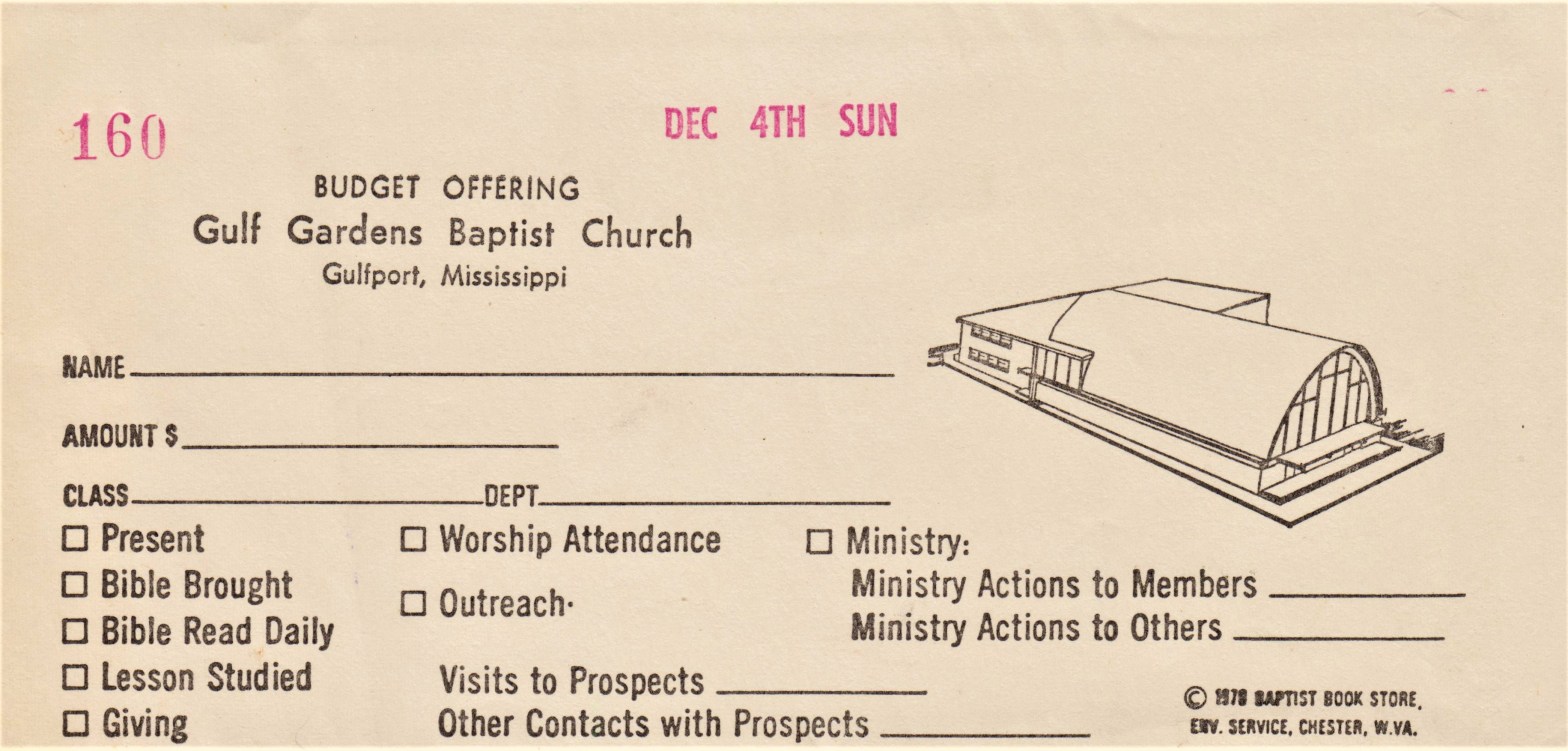
Every Sunday morning my father doled out an allowance to me of $3.50. I then put two quarters into an envelope for the offering plate. The envelopes (similar to the one pictured) were pre-printed with boxes to check off. As a child, I could not check all the boxes, but they reminded me of the habits the church was encouraging. My envelope would look like this:
√ Present
√ Bible Brought
__ Bible Read Daily
__ Lesson Studied
√ Giving
√ Worship Attendance
__ Ministry
__ Outreach
There was not a box for fasting. In fact, fasting was only ever mentioned at church as a sort of historical curiosity. Moses fasted for forty days. Jesus fasted for forty days. We talked about that during Sunday school. Maybe we even charted it in pictures on a flannel-graph board. But no one ever suggested that fasting was something I would do.
Until Bart Glatt began talking about it with members of the youth group. One Tuesday night, this man I respected began talking about fasting like it was the most natural thing in the world. Fasting? What?
Long story short, I discovered that fasting is a normal part of the Christian life. It will never be as common as “Bible Read Daily” or “Worship Attendance,” but it ought to come up now and then.
When the Jews were released from Babylonian captivity, Ezra led several thousand from Babylon back to Jerusalem. This four-month journey was a walk of over 900 miles through dangerous terrain. I don’t know anyone who has completed such a difficult trip.
“Then I proclaimed a fast there, at the river of Ahava, that we might afflict ourselves before our God, to seek of Him a right way for us, and for our little ones, and for all our substance … So we fasted and besought our God for this: and he was intreated of us” Ezra 8:21,23.
Ezra knew God wanted the Jews to return to Israel. He also knew that God promised to protect His people. But Ezra did not take God’s promises for granted. God wants to bless us—He enjoys blessing His children—but God often delivers His blessings through prayer and fasting. Given the seriousness of the occasion, and the risks attendant upon bringing 2,000 families across 900 miles of desert wasteland, Ezra led the people not only in prayer but also in fasting. Several months later, they reached Jerusalem safe and sound.
But is fasting really a thing? Well, the Bible record includes many more than just Moses and Jesus. Elijah fasted 40 days running from Jezebel. Daniel fasted several times. Esther called the Jews to a three-day fast. David fasted to mourn the deaths of Saul, Abner, and his unborn child. Nehemiah fasted over the broken walls of Jerusalem. The city of Ninevah fasted in repentance after the preaching of Jonah.
But that’s Old Testament stuff, right?
No. The Bible speaks of fasting throughout both the Old and New Testaments.
Jesus did not say “IF you fast,” but “WHEN you fast….” Jesus ASSUMED His followers would fast.
“When you fast, put oil on your head and wash your face, so that it will not be obvious … you are fasting…” Matthew 6:16-18.
Here are some New Testament examples of fasting: Anna the Prophetess “served God night and day with fasting and prayers” Luke 2:37. The disciples fasted. Paul fasted after his Damascus Road conversion. And Paul and Barnabas fasted before choosing church leaders.
Notice that fasting is not just for matters of life and death. We also fast for revival and missions, or spiritual growth, or matters of church life, such as choosing a pastor.
Presently, I fast one meal a week. I would not call the issue I am praying about a matter of life and death. But it matters to me. I have a prayer need that I want to see God answer. And scripture has convinced me that God will respond to fasting.
Do you have a prayer need or a person you are praying for? If you are discouraged in your prayers or simply looking for some way to “strengthen your claim” before the Lord, consider adding fasting to your spiritual regimen.
Dear God, as the disciples said, “Lord teach us to pray.” But also, Lord teach us to fast.
AΩ.
 Household Words: