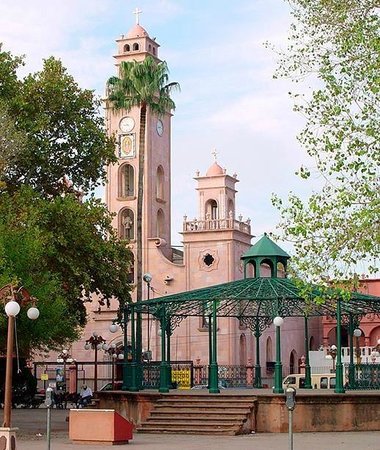
Image: the square in Piedras Negras, Coahuila, Mexico.
“Marisela, listen to me. I understand that you left your homework at home. I get it. But I’m required to take points off for late assignments.”
I was a first-year English teacher. Marisela was a sophomore in a border town. I had been hired to replace a permanent sub, a local young lady who had not managed to finish college but was pretty and enormously popular with the students. My students saw me as the young white guy who showed up on the third week of school to take a job away from the sweet Latina woman. Several students gave me the benefit of the doubt and we remain friends thirty years later. Others did not.
Marisela continued to argue: “But my mom is bringing my work after school!”
“Don’t yell, please. I understand that your mother is bringing the work after school—”
“And that’s today! So it’s not late! ¿COMPRENDE? ¡GRINGO!”
I sent Marisela to the office to comprende some manners.
Eagle Pass is unusual. Not only is it a border town, but it is culturally overwhelmed by the much larger city of Piedras Negras on the other side of the Rio Grande. (Recent population data shows Piedras Negras to be ten times the size of Eagle Pass.) Thus, the culture of Eagle Pass is more heavily influenced by Mexico than many other American border towns.
The schools reflect these trends. U.S. News & World Report indicates that the school district is 0.9% White-non-hispanic, 0.1% Black, 0.1% Asian, 1.6% American Indian, and 97.1% Hispanic. Further, everyone in Eagle Pass speaks Spanish, some much better than others. I did not speak Spanish at all.
Like teachers everywhere, I was bombarded with student voices all day, many of them talking when I needed them to be quiet. The difference was, I often had no idea what they were saying. If I assumed they were talking about me, I would be upset all the time and would handle everything badly. So I chose to assume the best, to assume they were not talking about me even when they probably were.
On top of that, I was seven hours from home: seven hours from all my family and friends. Seven hours from my fiancée. For me, Eagle Pass was a means to an end, a year-long way-station on the path to teacher certification. A year of offending some just by being there, a white man from the interior who took a local woman’s job. A year of being talked about and insulted, often in a language I did not understand. A year of being isolated in a city far from home. A year paying hundreds of dollars in long distance telephone bills. A year of loneliness, extremely hard work, and precious little support[1].
I love the first line of Psalm 120: “In my distress I cried unto the Lord, and He heard me” Psalm 120:1.
Doesn’t that say it all? I mean, isn’t that reassurance all that we really need? We need for God to hear us when we cry out to Him. And He does. Amen.
“I cried to the Lord in my trouble, and He answered me. Rescue my soul, Lord, from lying lips, from a deceitful tongue … Woe to me, for I reside in Meshech, I have settled among the tents of Kedar [two extremely distant places]. Too long has my soul had its dwelling with those who hate peace. I am for peace, but when I speak, they are for war” Psalm 120:1-7.
The writer is suffering and calls out to God—and God hears him.
He has trouble: God hears.
He is lied about: God hears.
He lives far away in a lonely land: God hears.
He lives among people who want to attack him: God hears.
His efforts to make peace are rejected: God hears.
“In my distress I cried unto the Lord, and He heard me” Psalm 120:1.
Doesn’t that say it all?
I cried to the Lord and He heard me. Amen! Cry out to God. He hears you!
Dear God, remind us—SHOW us—that You hear our prayers. You answer our prayers. You love us, You protect us, You sustain us in long, difficult times. You have a plan for our lives. Walk with us. Comfort us. Remind us of Your presence. ‘Jehovah Shammah. You are the one who’s standing near.’ Amen. Thank you, Lord.
AΩ.
[1] It was unpleasant for me at 24, but let’s not overstate the case: no one was shooting at me. This was not war, just a difficult high school. The complaints of the psalmist make my story sound so benign. Moreover, by the time the year ended, I had grown to love my students. Eagle Pass is a beautiful city in the desert, with a gorgeous sunset every night. I’ll never forget looking down the hill across the Rio Grande at the city of Piedras Negras atop the cliffs on the other side. Eagle Pass is a good place filled with great people, and I have been back with my wife and kids several times.
 Household Words: