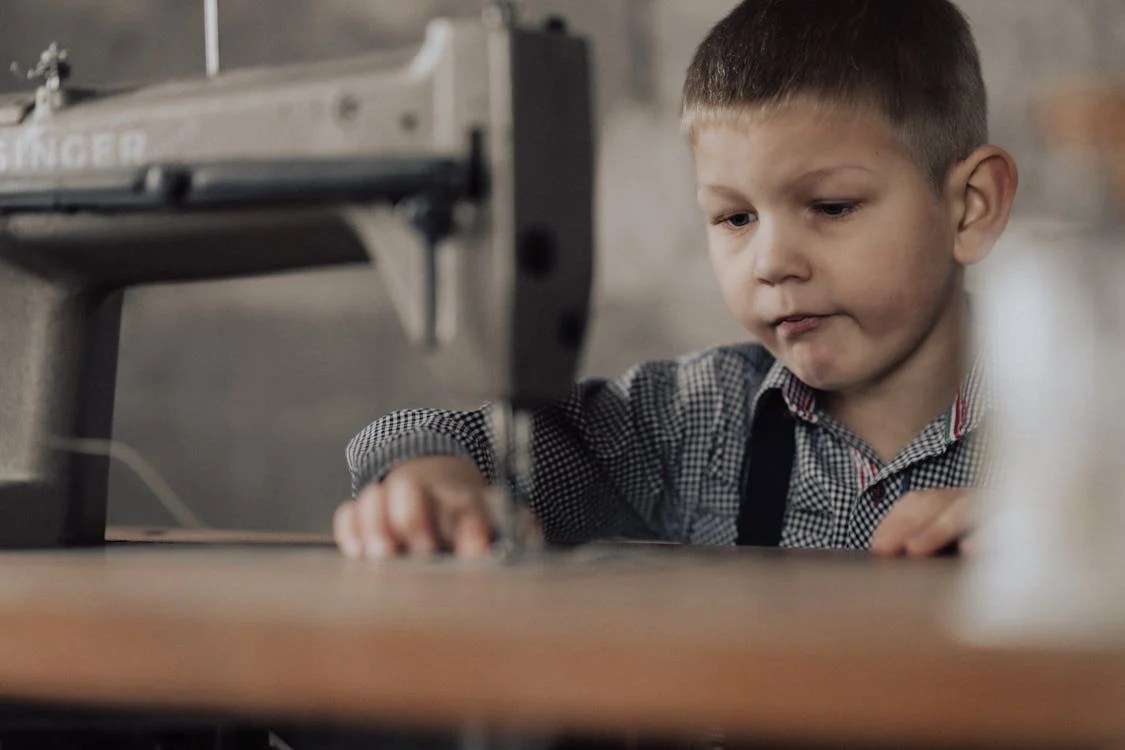
Orville Wright famously skipped kindergarten and spent a day hiding in a barn, where he took a sewing machine apart and then put it back together. Why? To figure out how it worked. In other words, a very young Orville Wright, one of the inventors of the airplane, was able to intuit a process we now call “reverse engineering.”
If engineering begins with nothing and designs a new product, reverse engineering begins with the completed product and works backward to figure out how it was made[1]. Reverse engineering is being done every day by engineers and inventors around the world, eager to copy and improve upon the latest electric vehicles, gaming consoles, cell phones, medical devices, advanced robotics, and thousands of other useful items.
Reverse engineering is also a useful metaphor for a way of thinking about things in the Bible. For example, we normally understand the sacrifice Jesus made for us by thinking about the sacrifices in the Old Testament. But we can use reverse engineering to understand the Old Testament sacrificial system by beginning with the crucifixion and working backwards.
What I mean is this: God knew He would use His own blood to pay for our sins. God saw the cross coming “from the foundation of the world” Revelation 13:8. With that in mind, God created the system of blood sacrifices in the Old Testament to help His people understand the sacrifice on the cross that would come later. But with reverse engineering, we can begin with the cross and look backward to gain some understanding about the Old Testament sacrifices.
Truths About the Sacrifice of Christ:
- We are talking about death, not merely bleeding. “The life is in the blood … and it is the blood that makes atonement” Leviticus 17:11. In context, this verse says no one is allowed to eat or drink blood. Why? Because “the life is in the blood.” And just as Jesus would be crucified ‘to death,’ the animals were also killed. Could God have created a system where a priest would remove some blood from an animal, put the blood on the altar, then allow the surviving animal to be released? Yes. But that would not have foreshadowed the death of Christ. God knew from the beginning that Jesus, the holy God-Man, would have to die to provide the sacrifice. There is a substitutionary death involved, not merely the shedding of blood.
- “Without the shedding of blood there is no remission of sin” Hebrews 9:22. We are saved by placing our faith in Jesus, who shed His blood to pay a debt we could never pay on our own—because apart from Christ, our blood can never be holy.
- God’s children sacrificed animals out of obedience. But animal sacrifices would never atone for their sin. “It was not by the blood of goats and calves. He took His own blood, and with it, He, by Himself, made sure of eternal salvation” Hebrews 9:12. The system of sacrifices allowed the people to participate in a ritual that taught them about sin and about the need for blood atonement. The system also allowed them to demonstrate obedience and faith. They knew to place their faith in God; this was never about the death of animals.
- “Jesus offered His blood, once for all” Hebrews 7:27. The constant, bloody, never-ending system of sacrifices ended at the cross. Sacrifices no longer had to be made over and over again. Jesus paid it all, once—for all time.
- Jesus’ blood was shed for you and me and everyone. As He said in the last supper with His disciples, “This cup is the new covenant in My blood, which is poured out for you” Luke 22:20. Though only the Jewish people participated in the Hebrew sacrificial system, the blood of Jesus is for everyone, both Jews and Gentiles.
- The Old Testament sacrifices of animals could not provide atonement. “For it is not possible that the blood of bulls and goats should take away sins” Hebrews 10:4. Again, the sacrificial system was a teaching tool, a foreshadowing. From the beginning, God’s system of sacrifices looked forward to the sacrifice of Jesus on the cross. It is Jesus who bears our burdens, Jesus whose stripes heal us.
Truths We Learn From the Cross About the Old Testament Sacrifices:
Animal sacrifices were an illustration of the sacrifice to come.
God created the system of animal sacrifices to teach His people about their need for atonement. “And this is the thing that thou shalt do” to make the priests holy, Exodus 29:1.
The animals had to die to illustrate the gravity of sin and the need for a substitutionary death.
Jesus had to die for our sins, not merely bleed.
Animal sacrifices would never be able to satisfy the holiness of God, and therefore had to repeated over and over.
But where “Aaron shall make atonement … once a year … throughout the generations” (Exodus 30:10), Jesus would make a single sacrifice, once for all time, then take His seat at the right hand of the throne of God, Hebrews 10:12.
God’s people knew He would provide something better than animal sacrifices. They did not understand exactly what was coming, but they knew God would provide.
As Job put it, “I know that my Redeemer lives, and that in the end, He will stand upon the earth, and after my skin has been destroyed, yet in my flesh I will see God … How my heart years within me!” Job 19:25-27.
Dear God, Thank you for providing salvation for us through the blood of your Son! And thank you for the complex sacrificial system with its temple, priests, sacrifices, and celebrations, rituals, and feast days throughout the year. Thank you for creating activities and teaching tools so that even centuries later we understand the mysteries of the cross better than we would have otherwise. May we never fail to study the rich truth of both the Old Testament and the New. We love you.
AΩ.
[1] For example, when TWO PESOS elected to copy Taco Cabana, they hired chefs to reverse engineer every item on the menu. The case reached the U.S. Supreme Court, and a great deal of information is available online. I like the Wikipedia summary https://en.wikipedia.org/wiki/Two_Pesos,_Inc._v._Taco_Cabana,_Inc. and this “student project” posted by Cornell: https://courses2.cit.cornell.edu/sociallaw/student_projects/Tradedresspage2.html
 Household Words:
One thought on “Reverse Engineering a Look at the Sacrifices. Exodus 29:1.”