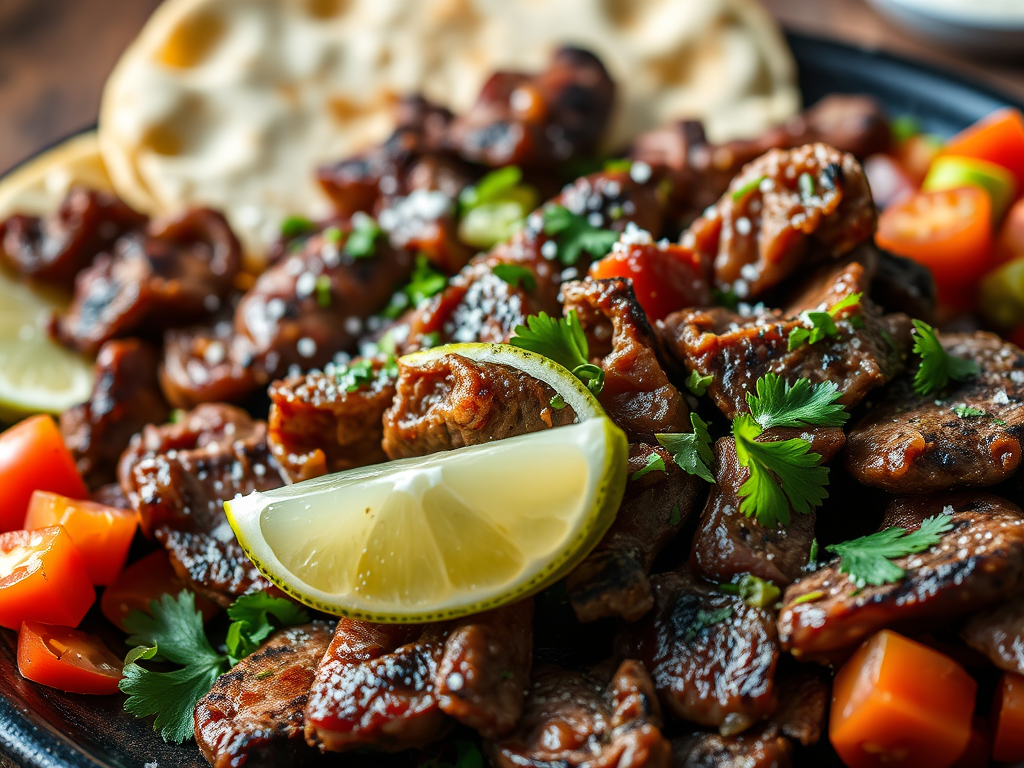
Image created with A.I. (they are getting better quickly!).
Last week I met my buddies Paul and Chris for lunch at Lupe Tortilla Mexican Restaurant. After I had dutifully chosen something with the word ‘vegetable’ in the name, Paul suggested the three of us share an order of beef fajitas for two. It was Paul’s birthday. Why not? And if three of us split an order for two—perhaps we would not overeat.
The chips and salsa were okay. The flour tortillas were adequate. The guacamole was good enough. The diced cilantro, lettuce, and tomatoes were fine.
But the beef! It was tender, savory, salty, sweet, and perfect. I once described roasted mutton as ‘Biblically succulent.’ This was better. Just thinking about it now has my mouth watering and my stomach rumbling.
A food writer and former waiter describes fajitas: “The meat should be ultra juicy, with an overwhelming, almost buttery beefiness—this is skirt steak, after all, the butteriest of all beef—accented by a fajita marinade that’s slightly sweet, very savory, and packed with lime and chile.”[1] I’ll take his word for it. All I know is that the meat was delicious.
Not long after the Israelites left Egypt, God began giving them instructions for sacrifices.
“If his offering be a burnt sacrifice of the herd, let him offer a bull without blemish” Leviticus 1:3.
“And if his offering be of the flocks, namely of the sheep or of the goats for a burnt sacrifice, he shall bring it a male without blemish” Leviticus 1:10.
“And if the burnt sacrifice for his offering to the Lord be of fowls, then he shall bring his offering of turtledoves or of young pigeons” Leviticus 1:14.
Why do some sacrifice bulls, others goats and lambs, and still others birds? Because God understands that some people are much wealthier than others. You sacrifice what you can.
There was more to meat offerings than simply meat. They were prepared with fine flour, oil, and “with all thine offerings thou shalt offer salt” Leviticus 2:13. Some of the sacrifices were entirely burned in the fire, some were partially burned up, and partially consumed by the priests, and some were partially burned, partially consumed by the priests, and partially consumed by the worshipper who presented the sacrifice. The result varied according to what type of sacrifice was being offered.
But always a portion was burned in the fire, as “a sweet savor unto the Lord” Leviticus 1:9. Having read the descriptions of the meat, salt, oil, fine flour, and even frankincense, it was undoubtedly “a sweet savor” not only to God, but to the people. It sounds delicious.
And that’s part of what makes it a sacrifice: not only did you give up an expensive bull, but—in the case of a burnt offering—you smelled the aroma, but did not get to eat any of it.
There is more to sacrifices than meat, salt, and flavorings. This is not a mere recipe.
The sacrifice is about the heart.
Notice the repeated phrase: “a male without blemish” Leviticus 1:3. God asked His people to present to him their best. He specifically requires that the animals have no broken bones, and cannot be blind, lame, spotted, or have any other defect. Otherwise, a shepherd might choose to give God the worst of the flock rather than the best. But as David put it, “Shall I bring to God a sacrifice that costs me nothing?”1 Chronicles 21:24.
God asks us to give Him our best!
And no matter how well you might follow the recipe, God will only be pleased if you come to Him with a heart filled with humility, worship, and repentance. God designed the sacrifice as a way to seek forgiveness and restore the relationship with Him. May we always give Him our best!
“I cannot offer burnt offerings to the Lord that cost me nothing” 2 Samuel 24:24.
AΩ.
[1] https://www.seriouseats.com/grilled-skirt-steak-fajitas-food-lab-recipe This article by a New York Times food columnist goes on to credit Houston’s NINFA’S on Navigation for being one of the first restaurants to offer fajitas. Best part of the article? The story about the way waiters are trained to take the longest, most circuitous route possible to the table, knowing that the more people they pass with sizzling iron skillets of still-grilling fajita meat, the more orders will flood in. “The approaching noise of sizzling meat would halt all conversation as diners would gently lift their chins, tilting their noses in the air to catch a whiff of beef, onion, garlic, and chile … if a waiter could sell one of our Extreme Fajitas to a table in his section, a half dozen more orders would quickly follow.”
 Household Words: