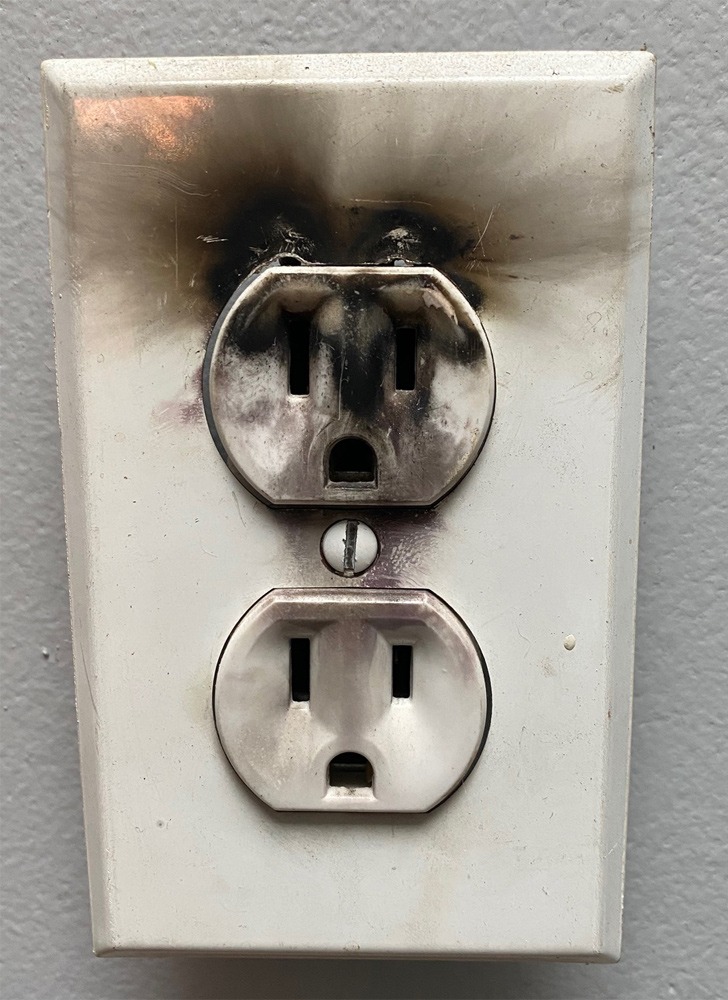
I had to be taught to respect electricity. Before I learned, I played games with it. Once I held a long nail above a lamp plug. I loosened the plug just enough to expose the two metal prongs, but the lamp was still lit. Experience had taught me that the prongs would shock me if I got too close. From about an inch above, I held a nail across the two prongs. Then I let it go and the nail fell across the prongs like a bridge.
Instantly, there was a loud zap, the wall outlet turned almost completely black, and all the plugs in my bedroom went dead. The room smelled like fire. Even with the lamp out and smoke trailing up from the outlet, I could see that the nail had sunk halfway through the two prongs before melting into them, fusing the three pieces of metal in a primitive arc weld.
I was in big trouble. My father understood electricity. More importantly, he respected it. In addition to whatever punishment he meted out, he left me with a room full of dead outlets for months. Although he could easily repair the damage I had caused, he was in no hurry.
Having heard of a recent electrocution, I did some reading. The news stories involving electricity are terrible. One girl of 14 died after she took an extension cord into the bathroom so she could charge her phone while using it—from the bathtub. Police verified that the phone never got wet, but the girl may have touched a frayed wire from the extension cord which caused her death.
The stories of construction workers dying while working household repair jobs are legion. An average of 143 construction workers are killed by electricity every year. Some touch wiring, some touch downed power lines, some innocently touch a household appliance (like a stove) that has been electrified by bad wiring.
Electricity is an amazing tool. Among energy sources (natural gas, coal, gasoline, electricity) electricity is unique. Nothing rivals the versatility and efficiency of electricity. Nothing else could power circuits or operate computers. A world without electricity could produce heat, air conditioning, and cooking. But not radio, television, or computers. The invisible, lightning-fast current is powerful, but dangerous. Essential but deadly. We must respect it.
Moses’s brother Aaron had two sons, Nadab and Abihu. They did not learn this lesson.
The brothers saw the miracles in Egypt. They witnessed the Passover. They saw God part the Red Sea. The two became priests and they participated with Moses and Aaron in the rituals God used to create a holy tabernacle out of ordinary raw materials. But somehow the two did not gain a proper respect for God’s holiness:
“And Moses took the anointing oil and anointed the tabernacle … he anointed the altar and all the vessels … he poured anointing oil on Arron’s head and anointed him, to sanctify him … he brought the bullock for the sin offering … he brought the ram for the burnt offering … he brought the ram of consecration … And Moses took of the oil and the blood which was upon the altar, and sprinkled it upon Aaron, and upon his garments, and upon his sons, and upon his sons’ garments, and sanctified Aaron and his sons … So Aaron and his sons did all things which the Lord commanded by the hand of Moses” Leviticus 8:10-36.
“And the glory of the Lord appeared unto all the people. And there came a fire out from before the Lord, and consumed upon the altar the burnt offering and the fat, which when all the people saw, they shouted, and fell on their faces” Leviticus 9:23-24.
“But Nadab and Abihu, the sons of Aaron, placed unholy fire in their fire pans, laid incense on the fire, and offered the incense before the Lord—contrary to what the Lord had just commanded them! So fire blazed forth from the presence of the Lord and destroyed them. Then Moses said to Aaron, ‘This is what the Lord meant when He said, ‘I will show myself holy among those who approach me, and I will be glorified before all the people.’ And Aaron was speechless” Leviticus 10:1-3.
Moses and Aaron loved Nadab and Abihu. These were Aaron’s sons and Moses’s nephews. But they crossed the holiest of lines and paid for it with their lives.
Lest you think this is strictly an “Old Testament thing,” God similarly struck down Ananias and Saphira in Acts 5. We must respect God’s holiness. No, we do not operate temples and perform holy sacrifices with sheep and goats. But He commanded us to “Be holy, as I am holy” 1 Peter 1:16. Will we always be holy and never sin? No.
But God is always holy. We must respect God and remember and honor Him as holy. We must honor His word as holy. We must honor the Bible’s wisdom as holy, not assume it is outdated. Search your heart. Do you honor God? Do you revere Him? Do you remember how great He is and how small you are?
Do you yield your opinions and preferences before the holy authority of God’s word?
Dear God, teach us to honor Your holiness. Remind us that because You are holy, You are also good and kind and merciful and compassionate. We are blessed because You are holy. But we ask You to inspire us and teach us about Your holiness. Equip us to worship You better and more deeply as we grow to understand what holiness really means. We love you!
AΩ.
 Household Words: