Under Old Testament law many things could render you ceremonially unclean, including childbirth, skin diseases like leprosy, certain bodily discharges, and contact with unclean animals. To be unclean was to be unfit to participate in temple worship. Various ritual washings were required to restore a state of cleanliness.
Being ceremonially unclean was not necessarily sinful or even the result of sin.
There were circumstances such as leprosy that would render the innocent unclean—though innocent. But uncleanness did share some characteristics with sin, one of which was that it could be measured in degrees.[1]
Some types of uncleanness lasted only until dusk on the same day. Others multiple days. And the one that lasted the longest and required the most elaborate efforts to restore a person to a state of ritual cleanliness was the uncleanness caused by contact with dead bodies.
Numbers 19 begins by explaining how to prepare the sacrifice of a red heifer, burn its carcass, and mix the ashes in water to create a ritual cleansing water with which to wash those who have touched the dead. (This became a water that, something like the yeast in a batch of sourdough bread, could—and did—last for centuries. The priests simply added new water to the old, and historical records indicate a thousand years passed before the sacrifice of a second red heifer. More on that below.)
“The one who touches the corpse of any person shall be unclean for seven days. That one shall purify himself from uncleanness with the water [from the ashes of the red heifer] on the third day and on the seventh day, and then he will be clean; but if he does not purify himself on the third day and on the seventh day, he will not be clean. Anyone who touches a corpse, the body of a man who has died, and does not purify himself, defiles the tabernacle of the Lord; and that person shall be cut off from Israel. Because the water for impurity was not sprinkled on him, he shall be unclean; his uncleanness is still on him.
“This is the law when a man dies in a tent: everyone who comes into the tent and everyone who is in the tent shall be unclean for seven days. Every open vessel, which has no covering tied down on it, shall be unclean. Also, anyone who in the open field touches one who has been slain with a sword or who has died naturally, or a human bone or a grave, shall be unclean for seven days” Numbers 19:11-16.
Why was contact with the dead the most severe type of uncleanness? Why was it that he who touched a dead animal was unclean for only one day, but he who touched a dead man was unclean for a week? And why was this uncleanness contagious: why did it render unclean those in the room with the dead even if they did not touch the body? Why did the uncleanness of death contaminate everything that was later handled by those who first handled the body? And it infected open dishes in the room. Clothes. All sorts of things had to be cleaned. Why?
Why were dead bodies the most unholy defilement on earth?
For one thing, God is teaching His people the importance of hygiene some thirty centuries before microscopy would lead to the discovery of germs. It is a valuable lesson: everyone who touches the dead, even bones long dried in the sun, must wash and avoid various activities for seven days. And today we know: dead bodies can spread infection and death. As noted in the book, NONE OF THESE DISEASES, there is a hygienic purpose to passages like this one. But there is also a spiritual purpose.
Why were dead bodies the most unholy defilement on earth?
Because death was the greatest, most grotesque consequence of the sinfulness of man. “You shall surely die” Genesis 2:17.
Uncleanness—while not caused by sin (after all, the living have no choice; we MUST handle the dead)—uncleanness is a picture of life on this earth. Death is all around and so is sin, and we are touched by both every day. We do not live in a state of holiness, nor are we surrounded by holy people.
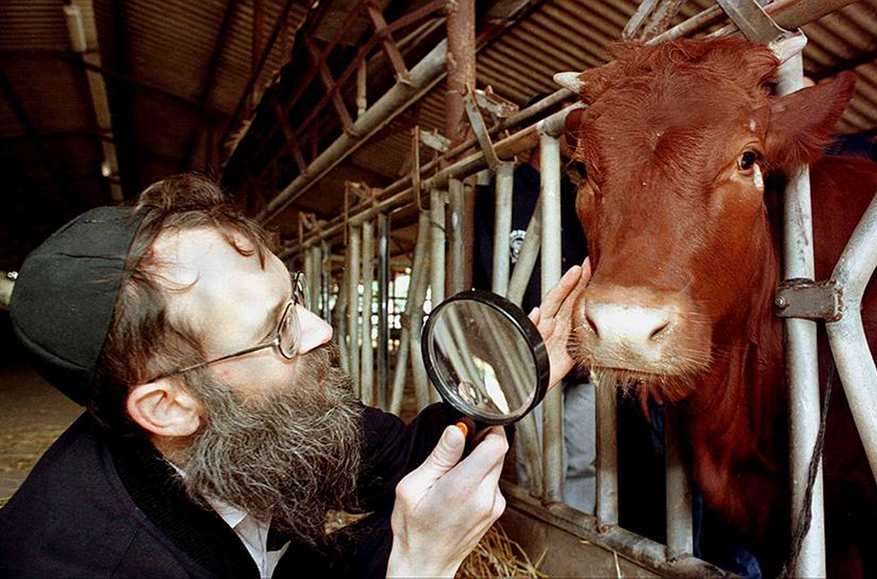
The red heifer is a picture of Christ. It must be perfectly red. A single white or black hair will disqualify the animal–and the rabbis check the hairs with a magnifying glass (pictured–see also the discussion of recent red-heifer news in the footnotes).
The red heifer is the Bible’s only sacrifice for which a color is designated. Many believe the red color is symbolic. The Hebrew word for red is related to the word for “earth.” This prefigures Jesus: because He became a Son of Man, a son of Adam, “the Second Adam” (1 Corinthians 15:45) and Adam was crafted from clay, Genesis 2:7.
Also the red heifer was female to set it apart from the Egyptian practice of sacrificing red bulls. And the red heifer was slain outside the camp—the only animal sacrificed outside the camp, as Jesus would be slain outside the city walls. And the heifer would be slain not by a priest, but by a layman—the only animal sacrificed by a layman. Similarly, Jesus was crucified by the Romans, not by the Jews.
Finally, in a symbolic sense, the sacrifice of a single red heifer lasted for all time. The red heifer was the only animal sacrificed “once for all time.” Unlike other rituals and sacrifices, this single death would provide cleansing for thousands of people for as many as a thousand years. By one count, only nine red heifers were ever sacrificed. The one sacrificed in Numbers 19 by Eleazar, son of Aaron, was burned and its ashes could be added to water for cleansing for the next thousand years, from the days of Moses until the days of Ezra.
Maimonides, the great Jewish rabbi of the eleventh century A.D., reports that nine heifers were sacrificed during Israel’s entire history, “and,” he predicted, “the tenth will be sacrificed by the Messiah himself.” Of course, Maimonides might be surprised to learn that the tenth red heifer sacrificed to cleanse us from the defilement of death WAS the Messiah, and when Jesus prayed “not my will but Thine be done” (Luke 22:42), the Messiah, in a very real sense, did sacrifice Himself. As Jesus said, He came to “give His life as a ransom for many” Mark 10:45.
This is not an easy passage.
We Christians living thousands of years after Moses, must learn everything backwards by a sort of reverse engineering**: we are familiar with the story of the crucifixion, and only when reading Numbers 19 do we encounter this strange story about a cow slaughtered outside the camp to purify those living in a world of death.
But to the Jews living in the time of Christ, it was the story of the red heifer that was familiar, and the crucifixion of Jesus was the mysterious event that would only begin to make sense later.
But it would make sense. Because they understood uncleanness. The Jews were familiar with the sacrifice outside the city. They knew how desperately they needed cleansing, and they longed for a once-for-all-time sacrifice, rather than the daily flow of blood under the Old Testament system.
And that was Jesus, the great sacrifice, not only the last sacrifice, but in a sense, the ONLY sacrifice—because all others were mere types, mere symbols. All other sacrifices looked forward to the sacrifice of Christ, the One and only sacrifice that mattered.
“But this Man, after He had offered one sacrifice for sins for all time, sat down at the right hand of God,” Hebrews 10:12.
Like the red heifer, Jesus is the Only Sacrifice that was slain outside the city walls.
Like the red heifer, Jesus is the Only Sacrifice that was slain by laymen instead of priests.
Like the red heifer, Jesus is the Only Sacrifice that was slain once for all time.
“For if the blood of goats and bulls and the ashes of a heifer sprinkling those who have been defiled sanctify and cleanse the flesh, how much more will the blood of Christ, who through the eternal Spirit offered Himself without blemish to God, cleanse your conscience from dead works to serve the living God?” Hebrews 9:13-14.
Dear God, thank you for the way the Old Testament set the stage for the coming of the Messiah. Thank you for the sacrificial system and the scarlet thread running through the entire Bible so we might see that the entire story leads to our dramatic rescue when Jesus spilled His own blood outside the city as a ransom on our behalf.
AΩ.
[1] A dimmer switch has both an on/off switch and a dial to dim the light by degrees. Both sin and ritual uncleanness can be compared to a dimmer switch. That is, the two function first like regular light switches with on/off settings: a given act is either sinful or it is not, and at any given time a person is either clean or unclean. Your action is either sinful or holy. But there is also a dial to turn things up or down. The Bible indicates that some sins are worse than others and will be more severely punished both in this life and in the life to come. Similarly, some types of ritual uncleanness are more severe and last longer than others—the handling of a dead bodies being the most unclean, and the handling of a dead human body the most unclean of all.
The notion that all sins are equal is an error known as sin-leveling: https://dadsdailydevotionals.com/2024/03/27/sin-leveling-luke-1013-14/
Sin and ritual uncleanness can also be plotted on a Venn diagram: the two circles overlap. On one side there are sins that do not render the person unclean. In the center there are sins that do result in uncleanness. And on the other side are actions like contracting leprosy or touching a dead body that are NOT sinful, but result in uncleanness nevertheless.
* Believe it or not, as obscure as this ancient passage from Numbers 19 may be, the red heifer has been in the news recently. (Crazy, right?) Both Jews and Muslims living in Jerusalem believe/fear a Talmudic prophecy saying that the Messiah will come, sacrifice a red heifer outside the city, cleanse the Jewish people, and take them back into the city to rebuild the holy temple–on a site presently held by the Islamic temple known as Al-Aqsa and the nearby Dome of the Rock. To that end, in 2022, some Israelis imported from Texas a small herd of red heifers (I don’t think they purchased any bulls), and this action was cited by Hamas as reason for its attack on Israel of October 7, 2023. https://theins.ru/en/society/269112
** Because Christians use the Cross to understand sacrifices, it is a backwards view, like reverse engineering: https://dadsdailydevotionals.com/2025/08/26/reverse-engineering-a-look-at-the-sacrifices-exodus-291/
 Household Words: