
Image: Could you read on a crowded train?
President Lincoln was one of many lawyer-politicians. But Lincoln did not become a lawyer because he had his eye on a career in politics. Instead, Lincoln actually hung out a shingle, becoming a small business owner, a day-in, day-out lawyer for some twenty-five years, handling both civil and criminal trials, debt, slander, divorce, mortgage foreclosures, even murder. That’s why the most controversial decision of Lincoln’s presidency remains his suspension of habeus corpus during the Civil War—that is, Lincoln allowed the Union to arrest men suspected of being spies or enemies of the state and hold them in jail for months without due process.
Lincoln, the experienced criminal defense attorney, defended the decision, arguing that acts illegal in peacetime might be necessary “in cases of rebellion,” when the nation’s survival was at stake.
Every president since Lincoln is aware of what Lincoln did and will use it to justify war-time actions that have a chilling effect on dissent and deny the liberties of U.S. citizens.
During World War One, Americans passed the Espionage Act and the Sedition Act, restricting the freedoms of speech and of the press. During World War Two, the nation rounded up Japanese Americans and placed them in internment camps to ensure they could not act as spies for the Empire of Japan. Following the terrorist attacks of 9/11/2001, the nation passed the P.A.T.R.I.O.T. Act, enlarging the definition of “terrorism,” allowing for the “indefinite detention of non-citizens,” and greatly expanding the federal government’s power to “spy on the private lives of American citizens” through warrantless surveillance and so-called “secret searches.”[1]
The Roman statesman Cicero summed it up:
Inter Arma Silent Leges.
That means, “amid arms, the law falls silent.” In other words, during war, government leaders ignore the laws[2].
Lincoln knew it. Wilson knew it. Roosevelt knew it. And perhaps Moses knew it. Before Israel began a war to secure the Promised Land, God took the time to repeat the law to a new generation.
Knowing war was coming, God did not remind the nation merely to be strong or to have courage. God reminded the people of His commands, and of the essential nature of worship. God reminded them that what a nation at war needs is not more swords and missiles, but more sanctuaries and sacrifices. God reviewed with Israel the entire calendar, pointing out once again the many animal sacrifices required and exactly when and how to perform them.
Think of that. War is coming, first with the Midianites (as recorded in Numbers 31), then with the seven evil nations living in the Promised Land (as recorded throughout the book of Joshua). The young men are in a frenzy. Every nineteen-year-old has signed up with a military recruiter, and every sixteen-year-old little brother is plotting to lie about his age, afraid he will miss out on his chance for glory and heroism.
The families are worried, but proud. A surge of patriotism is sweeping the land. Flags and bunting hang from every front porch rail, yellow ribbons circle every oak tree, and then God interrupts the pre-war national pep rally to say, Slow down. Worship. Spend time with Me. God lays out in detail the communal sacrifices required of the nation.[3]
DAILY
God begins with the daily sacrifices: “This is the food offering you are to present to the Lord: two lambs a year old without defect, as a regular burnt offering each day. Offer one lamb in the morning and the other at twilight, together with a grain offering of a tenth of an ephah of the finest flour mixed with a quarter of a hinof oil from pressed olives” Numbers 28:3-5.
So every day, Israel would present two lambs in a sacrifice with flour and oil, along with a fermented drink offering to be poured out with each lamb (Numbers 28:7).
WEEKLY
Every week on the sabbath day, the number of sacrifices would double: Two lambs with flour and oil and a drink offering, in addition to the two already required every day, Numbers 28:9-10.
MONTHLY
“‘On the first of every month, present to the Lord a burnt offering of two young bulls, one ram and seven male lambs a year old, all without defect … Besides the regular burnt offering with its drink offering, one male goat is to be presented to the Lord as a sin offering” Numbers 28:11.
The monthly sacrifice was expanded to include two bulls, one ram, seven male lambs, and a male goat as a sin offering, each presented with flour and oil, and a wine offering to be poured out with each bull (Numbers 28:14).
ANNUALLY ON THE PASSOVER
“Present to the Lord a food offering consisting of two young bulls, one ram, and seven males lambs a year old, all without defect … Include one male goat as a sin offering to make atonement for you” (Numbers 28:19-22) and flour and oil (Numbers 28:20).
ANNUALLY ON THE FEAST OF FIRSTFRUITS
Again, two bulls, one ram, seven male lambs, and one goat for a sin offering, and the customary flour, oil, and wine for a drink offering, Numbers 28:26-31.
ANNUALLY ON THE FEAST OF TRUMPETS
This time it is not two but one bull, one ram, seven male lambs, and one goat for a sin offering, along with flour and oil, Numbers 29:2-5.
ANNUALLY ON THE DAY OF ATONEMENT
This one is the same as the above: one bull, one ram, seven male lambs, and one goat for a sin offering, along with flour and oil, Numbers 29:8-11.
ANNUALLY ON THE FEAST OF TABERNACLES
This eight-day festival raises the stakes:
DAY ONE: 13 bulls, two rams, 14 lambs, one male goat for a sin offering, and fine flour and oil, Numbers 29:13-16.
DAY TWO: 12 bulls, two rams, 14 lambs, one male goat for a sin offering, fine flour and oil, and drink offerings for each bull, ram, and lamb, Numbers 29:17-19.
DAY THREE: 11 bulls, two rams, 14 lambs, one male goat for a sin offering, fine flour and oil, and drink offerings for each bull, ram, and lamb, Numbers 29:20-22.
DAY FOUR: 10 bulls, two rams, 14 lambs, one male goat for a sin offering, fine flour and oil, and drink offerings for each bull, ram, and lamb, Numbers 29:23-25.
DAY FIVE: Nine bulls, two rams, 14 lambs, one male goat for a sin offering, fine flour and oil, and drink offerings for each bull, ram, and lamb, Numbers 29:26-28.
DAY SIX: Eight bulls, two rams, 14 lambs, one male goat for a sin offering, fine flour and oil, and drink offerings for each bull, ram, and lamb, Numbers 29:29-31.
DAY SEVEN: Seven bulls, two rams, 14 lambs, one male goat for a sin offering, fine flour and oil, and drink offerings for each bull, ram, and lamb, Numbers 29:32-34.
DAY EIGHT: One bull, one ram, seven lambs, one male goat for a sin offering, fine flour and oil, and drink offerings for each bull, ram, and lamb, Numbers 29:35-38.
This is another one of those cases where the Biblical text seems to call for a spreadsheet. This time I prepared one.
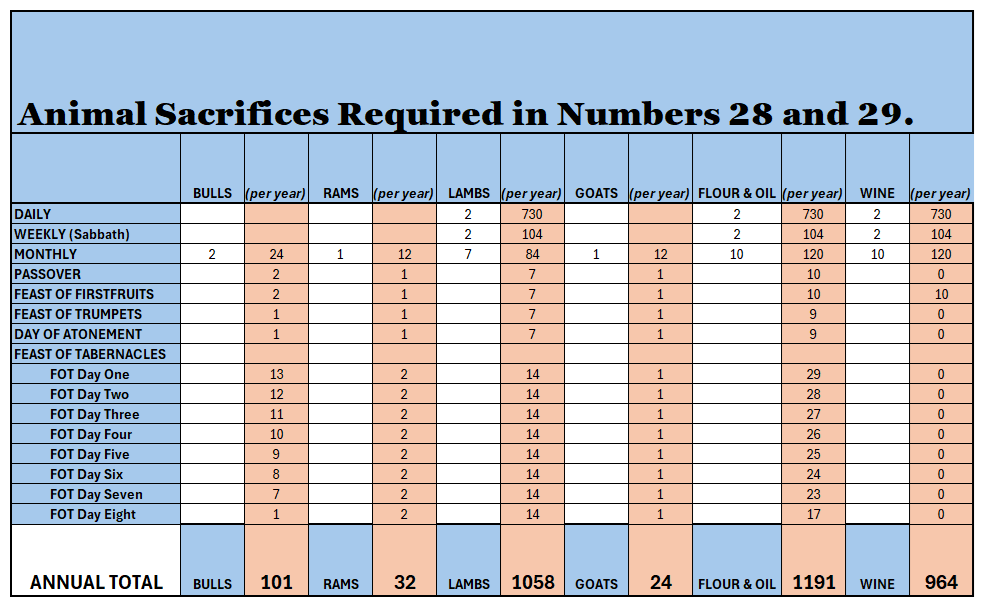
What is going on here? For one thing, God is taking the time to teach a new generation His laws. The generation that might have remembered the first time Moses taught on sacrifices—forty years earlier—died in the wilderness. Before bringing the nation of Israel into the land of Israel, God needs to teach them about proper worship throughout the entire calendar year.
Secondly, God is reminding the people that worship is important—more important even than going to war.
They serve God, after all. He delivered them from Egypt, has led them through the wilderness for almost 40 years, and He is the One Who will give them victory in battle. Worship and prayer are critical. The people must slow down and spend time with God.
Finally, a word of application:
I relate to the young men anxious to go to war. I remember the crazy, eager feeling of being a young man whose nation is under attack. We even felt the same way standing on the edge of fights that turned first into brawls and then riots in high school: there is a magnetic frenzy that can suck a young man into a fight like nothing else.
In that moment, the most difficult thing is for cooler heads to prevail. Reporters and onlookers refer to such a moment as a tinderbox, a tiny box of dried fire starter—introduce a single spark and everything will explode into flame instantly.
This is the sort of feverish ADD/ADHD that many of us think we are experiencing when we read passages like Numbers 28 and 29.
It is SO HARD to focus on the boring stuff!
It can be SO HARD to slow down and read or study some of the tough parts of the Bible.
But if God asked the young men of Israel to step back from the brink of war and concentrate on the details of the sacrificial system, perhaps we too can slow down, calm our distractable attention span, and focus.
Remember, this is the Word of God. The Creator of the universe prepared this book for you! Turn off the phone, the TV, the music, settle yourself, and FOCUS. Read the Bible! You can do this!
Dear God, teach us to concentrate on your amazing, rich, rewarding word! Help us to settle our minds, to clear our thoughts, and to hear from You! And bless our efforts with new insights and a greater dose of Godly wisdom. We love you!
AΩ.
[1] Every nation does it. When we are under attack, many would invite the government into our private business if we thought it would keep us safe. Benjamin Franklin commented on the willingness of worried citizens to surrender their freedom to the government: “Those who would give up essential liberty to purchase temporary safety, deserve neither liberty nor safety.”
[2] I gleaned this insight from an online version of the Matthew Henry Commentary. The Presbyterian minister penned a six-volume commentary on the old and new testaments, in spite of his death at the age of 51. Three hundred years later, his commentary remains one of the most highly regarded.
[3] Note that no single family is required to sacrifice hundreds of animals a year. Numbers 28 and 29 concern the sacrifices of the nation: “Numbers 28 – 29 is communal offerings. Those were done by Temple priests and funded by everyone’s annual half-shekel dues. (In fact, the Talmud’s tractate Shekalim is all about said public funds. These communal sacrifices must come from public monies!) The average family was responsible for a Passover lamb (which they could “go in on” with other families if needed), and some kind of offering at each pilgrimage. If someone wasn’t wealthy, those could be lambs too, so we’re talking four lambs. (Even then, the Passover lamb was mostly eaten by its owners.)” From– https://judaism.stackexchange.com/questions/124356/in-the-yearly-cycle-how-many-offerings-tithes-and-sacrifices-would-an-israeli#:~:text=For%20example%2C%20Numbers%2028:3,a%20hin%20for%20each%20lamb.
 Household Words: