Image: Erich Hartmann/Magnum Photos. From https://www.city-journal.org/article/with-meaning-for-all
After decades of taking my Bible to church every Sunday, I found myself bringing only my phone. One reason is that I have surrounded myself with chronological Bibles, which are AMAZING to read, but difficult to use during a sermon because chronological Bibles are not printed in a predictable order. (You can’t find anything!) A second reason is that Bible passages show up on the jumbotron anyway. Third reason? There is a pew Bible available. Fourth reason? I have a Bible app on my phone.
However, I have recently acquired a new Bible (printed in the traditional order) and I am bringing it to church with me every Sunday.
There is something to be said for hard copies, right?
When I worked as a litigator, I always had paper files at my desk. While typing a brief, I would look up at the monitor, then down at the papers—printed files, memoranda, printed copies of relevant caselaw. In my present work, I employ multiple monitors, often looking from the document I am composing on one screen over to a PDF on another screen. But when a task is particularly challenging, I still want a printout. I need something solid I can lay on the desk, that I can write on, that I can highlight, that I can scratch through and annotate in a dozen ways.
There is something to be said for hard copies.
When the children of Israel were preparing to cross the Jordan River into the promised land, Moses told them to immediately ascend Mount Ebal on the river’s western bank, and carve God’s law onto a series of large stones they would cover in plaster.
“Therefore, it shall be when you be gone over Jordan, that you shall set up these stones, which I command you this day, in mount Ebal, and thou shalt plaster them with plaster … And thou shalt write upon the stones all the words of this law very plainly” Deuteronomy 27:4,8.
Scholars are not certain whether the Hebrews set in stone the entire book of Deuteronomy or merely the summation of God’s commands embodied in the Ten Commandments. But what we know for certain is that all the civilizations in the area knew the technology for whitewashing and carving stones. The Israelites would have obeyed this command easily.
But why? Why would God ask them to set up large stones and carve words into them? The answer may seem obvious, but in this day of statue desecration, it is worth discussing.
Why do we build statues? Why do we create monuments? Why do we chisel our thoughts in stone?
You need look no farther than the local cemetery for the answer:
There is something to be said for hard copies.
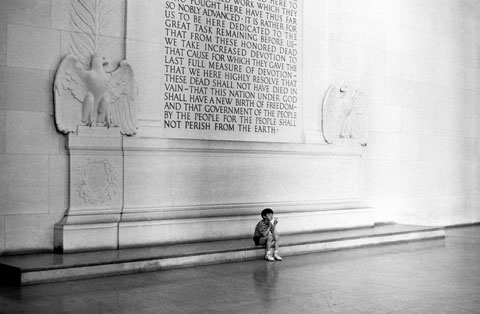
We erect tombstones not merely to mark a grave, but to memorialize a life. We carve words in stone so the words will remain long after we are gone. Carving words in stone is a way to speak to future generations. A great example is the Lincoln Memorial. The beautiful edifice is enclosed in a colonnade of 36 Doric columns, each 44 feet high, symbolizing the 36 states of the Union at Lincoln’s death. Lincoln himself is so huge that, were the statue to stand up, he would be 28 feet tall. And yet, it is the words carved into the walls of the memorial that seem to command the most attention.
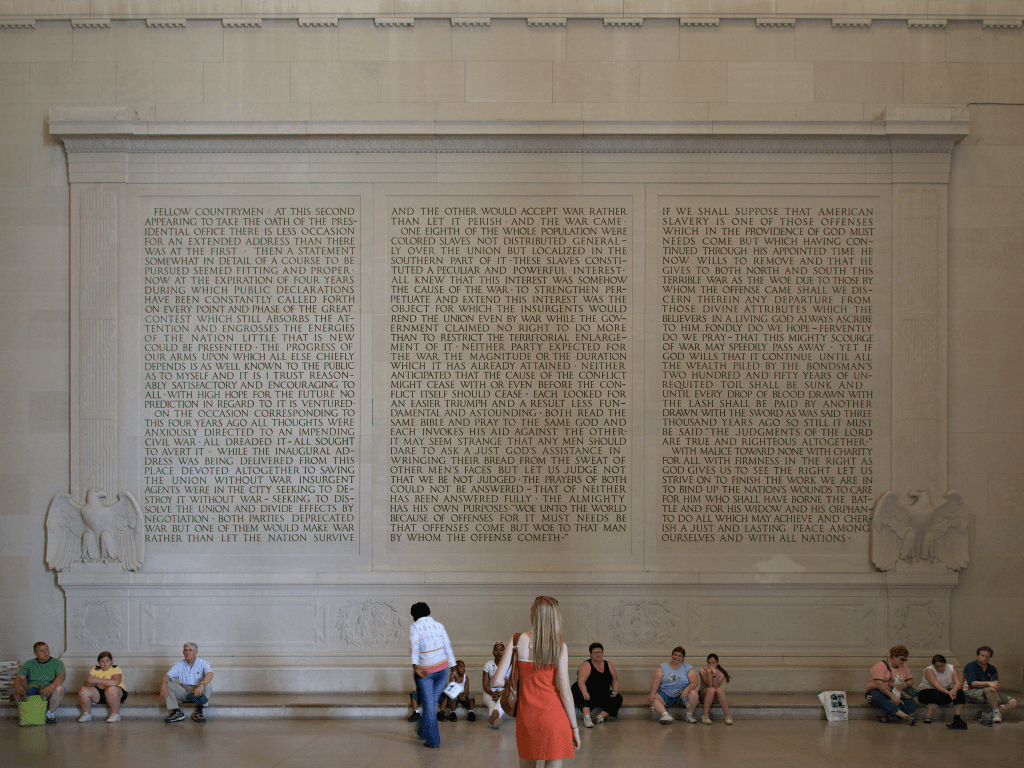
Image: https://commons.wikimedia.org/wiki/File:Lincoln_Memorial_%28north_wall_interior%29.jpg
“Inexorably eye and mind are drawn away from the figure to the left or right by the panels of text in the side rooms.”[1] Soon viewers find themselves wandering along the walls, reading the words of the Gettysburg Address and Lincoln’s Second Inaugural Address.
Written words matter.
My philosophy professor used to talk about the words scrolling from right-to-left across a digital stock ticker. The words move off the screen and seem to fall off into nowhere, disappearing forever. “Where do the words go?” he would ask.
Slightly more enduring are the virtual words created while text messaging. Words we type on the internet last a bit longer still. We print words we value. We bind in books words we value even more. But when words are deeply meaningful, when they resonate in the hearts of millions or undergird like a foundation the life of a nation, we carve those words in stone.
Israel valued God’s word so highly the nation carved it in stone.
Do we value God’s word that highly?
Did you know there is a writing surface more permanent than stone? It is the human heart. Words written there will last forever, 2 Corinthians 3:3.
When was the last time you carved God’s word into your heart?
When was the last time you memorized something from the Bible?
Imagine this hierarchy of the value of words: stock market ticker, text messages, words typed onto the internet, words printed on paper, words bound in books, words carved in stone, words permanently chiseled into your heart.
The words you value most will end up in your heart.
Memorize something!
AΩ.
[1] https://www.city-journal.org/article/with-meaning-for-all
 Household Words:
