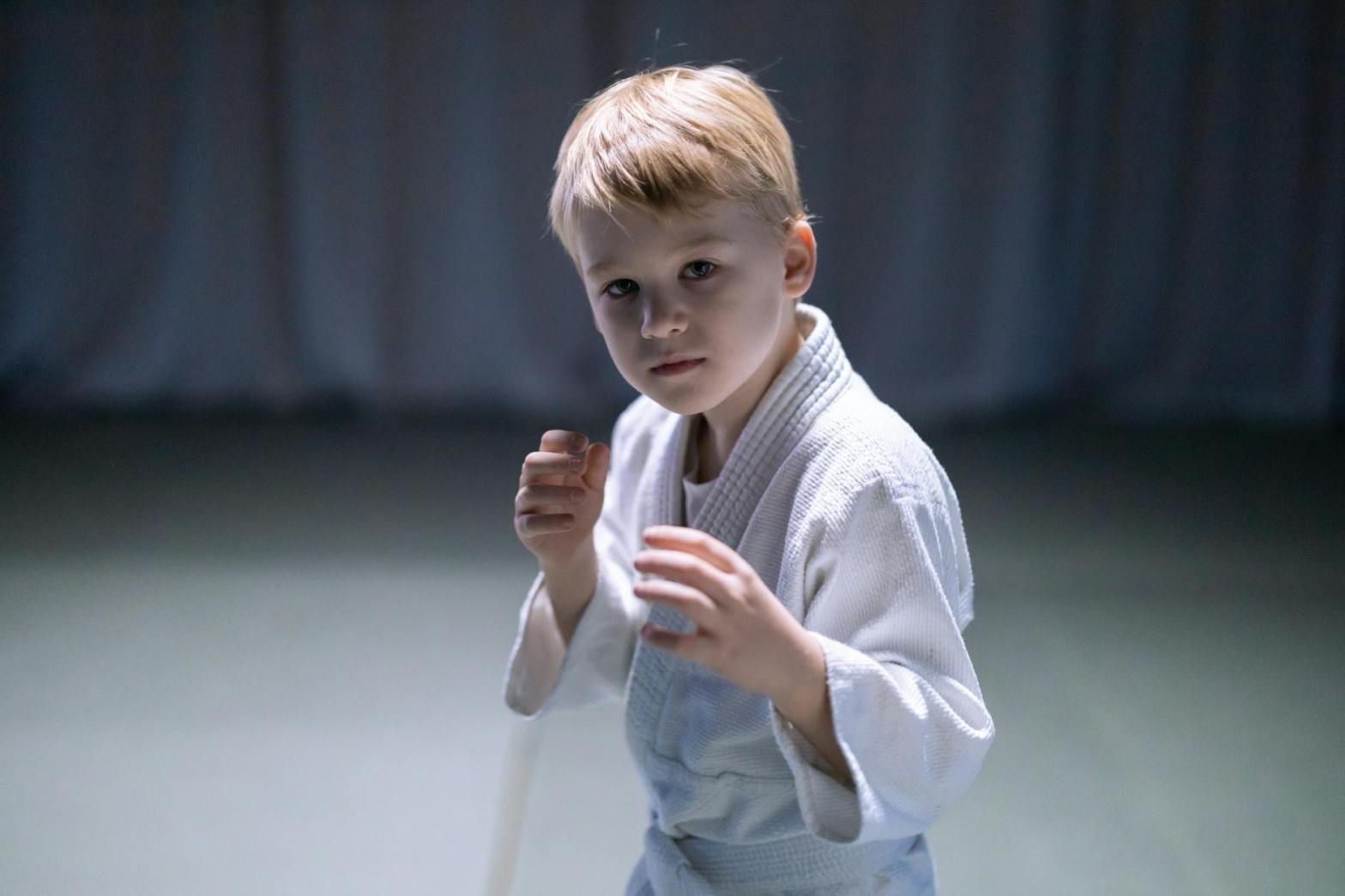
One day in sixth grade, we attended a school-wide assembly. Everyone gathered in the lunch room to watch a display by a local Taekwondo school. I knew that Paul, my buddy across the street, took classes there, so I was on the edge of my seat.
For about forty-five minutes, the men punched and kicked and snapped boards and broke bricks. The children were so excited, cheering everything that happened[1]. Then one of the highly decorated, black-belted Korean instructors took the microphone:
“And now, we have something special for you. We would like to call Paul Schmalz up to the stage … Paul? Are you here?”
Paul’s class began cheering and pointing and Paul (who is not shy!) proudly strutted to the stage. I’m not sure what he was expecting. But it was not what happened.
The man put his hand on Paul’s little shoulder.
“Children, does everyone know Paul?”
More cheering.
“Well, what you may not know is that Paul is a student at our school. Paul is a … what are you now, Paul, a green belt?”
“Green belt, blue stripe.”
“Ah, yes. Green belt, blue stripe. Well, children, Paul did not know we were going to call him up here today. And what Paul also does not know is that he is going to break his first board for you this morning.”
Suddenly Paul looked pale. I was in the back of the room, but I could tell he was terrified.
Paul had never broken a board in his life.
I was positive because if he had, I would have heard the story over and over. As I watched, Paul and the teacher had a quiet little conversation. Paul was trying to get out of it, but the master was not changing his mind. He gave Paul a little pep talk. Then he made him take a few practice punches.
I recognized everything that was happening because Paul constantly showed off all his skills on the kids in the neighborhood. There was the snap kick, the roundhouse kick, the snap punch and others. On stage, Paul began practicing snap punches, one fist shooting forward while the other snaps quickly back toward the body. He repeated the pattern over and over, warming up. Finally, the teacher decided he was ready.
Paul lined up in front of a man who was kneeling, holding a one-inch pine board in front of him. Paul let out a huge yell and gave that board his best punch—and nothing happened. The kids laughed. Then the master gave Paul a quiet little pep talk. Second try: huge yell, big punch, nothing. This time the crowd cheered and jeered. You could feel the shame in the air. This was about to become a moment of public ridicule–something the kids at our school had mastered. The instructor gave Paul another pep talk. Then Paul screamed like he was on fire, struck that board like his life depended on it, and his fist went right through it.
The crowd went wild!
For the rest of the day, everywhere Paul went kids wanted him to break boards and snap things. That meant mostly pencils, being the only wood available. There were broken pencils everywhere. For one day, one brief shining moment, Paul got to be the hero. And that night a hundred mothers must have called the Taekwondo school to ask how much the classes would cost. I know I begged to sign up. (My mom wasn’t having it.)
Sometimes all it takes is a good pep talk.
When the people of Israel moved into the land of Israel, they obeyed God and removed from the land many of the pagan Canaanites. But they did not remove them all. The tribes of Joseph suffered this failure of the will.
First Ephraim failed:
“And [Ephraim] drove not out the Canaanites that dwelt in Gezer, but the Canaanites dwell among the Ephraimites unto this day, and serve under tribute” Joshua 16:10.
The half-tribe of Manasseh also failed:
“The children of Manasseh could not drive out the inhabitants … but the Canaanites would dwell in the land. Yet it came to pass … that they put the Canaanites to tribute” Joshua 17:12-13.
Both tribes managed to subjugate the evil Canaanites, making them serve as forced labor (much as Israel had served the Egyptians). But they were unable to rid themselves of the Canaanites entirely, complaining that these idol-worshipping locals had “iron chariots,” Joshua 17:16.
But Joshua told them they were underestimating themselves. That is what we do, is it not? We get discouraged, assume we will never be able to break the board, and we try to quit.
We think too much of the challenge in front of us. We think too little of ourselves.
Joshua encouraged them:
“Joshua spoke unto the house of Joseph, even Ephraim and Manasseh, saying, ‘Thou art a great people, and hast great power … for thou shalt drive out the Canaanites, though they have iron chariots and though they be strong” Joshua 17:17-18.
We all need encouragement sometimes. We need great coaches, teachers, and parents to remind us of the power we possess, to remind us of our gifts, our talents, our strength. We need to be reminded of our Savior, who overcame the world, conquered the devil, and gives us new life. We can do all things through Christ!
As adults, we need to develop the skill of being our own encourager.
“David encouraged himself in the Lord” 1 Samuel 30:6.
Like David, you CAN learn to encourage yourself. Turn off the negative self-talk. Stop discouraging yourself. Stop worrying. Stop imagining the worst that could happen and make a choice to imagine the best.
Remind yourself of the power inside you, the way Joshua reminded the descendants of Joseph. Quote scripture to yourself!
Speak positively into your own heart, the way the taekwondo master spoke into Paul’s heart. Memorize these verses so you can recite them and pray them this way on your own behalf:
Dear God, remind me that I can do all things through Christ who strengthens me! (Philippians 4:13). I know that greater is He who is in me, than he who is in the world (1 John 4:4). I know that in all these things I overwhelmingly conquer through Him who loves me! (Romans 8:37). I am going to overwhelmingly conquer! Thank you, Lord. I will not give in to the temptation to quit because You will provide a way of escape (1 Corinthians 10:13). God, I fix my eyes on Jesus, the Author and Perfecter of the faith, who for the joy set before Him endured the cross, despising the shame, and has sat down at the right hand of the throne of God! (Hebrews 12:2). I am focusing on Him who endured such hostility by sinners against Himself so that I will not grow weary and lose heart (Hebrews 12:3).
AΩ.
[1] Actually, the students did not cheer for everything! If I had two best friends at the time, they were Paul and Chris. (Happily, we remain close almost fifty years later.) This story is about Paul, but it involves Chris too. One of the boards that was snapped broke in half and a big piece flew into the audience and hit Chris’s sister Heather in the face. She had to be taken to the nurse and probably went home (she was fine). The medical emergency nearly stopped the show. When the hour was over, our teacher asked Chris if he wanted to go to the nurse to check on his sister. He nearly got himself sent to the office when he replied, “No. I’m glad she got hit. I hope they hit her in the eye. She lied about me this morning and got me grounded for a month.” Mrs. Osborn was so upset, smoke was coming out of her ears. Years later, Heather told us stories of all the times she would punch holes in her own clothes (among other things) just so she could blame Chris for it and get him grounded. Their parents never seemed to suspect her.
 Household Words: