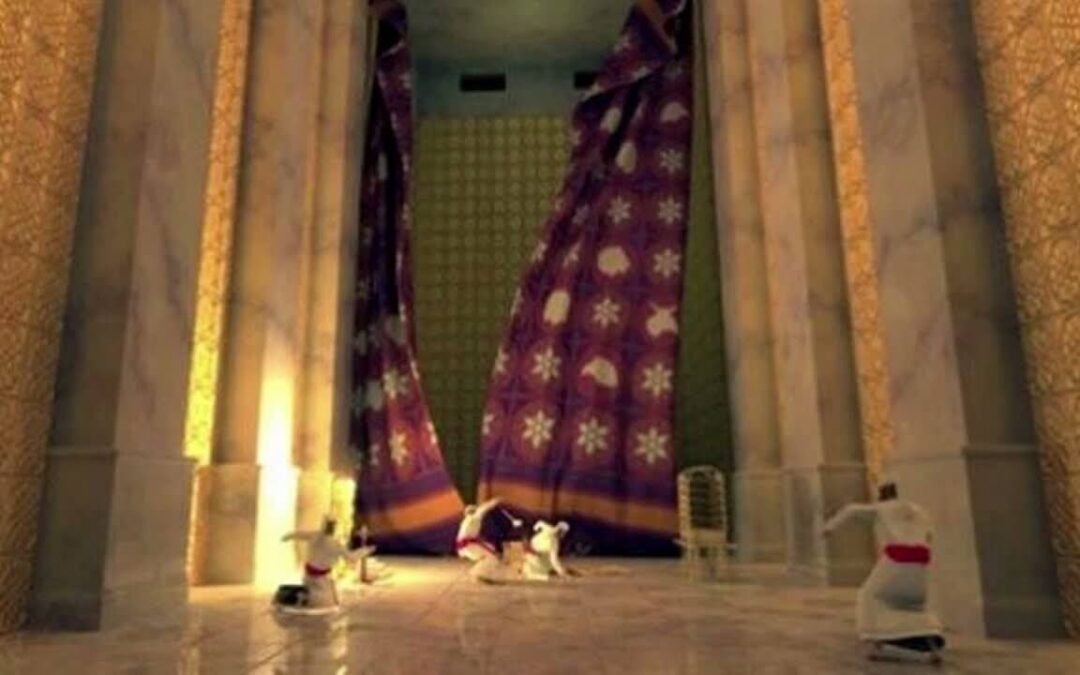
The week of the crucifixion and resurrection of Christ included some of the most mysterious events in all of Biblical history.[1] One that must have been shocking was that the veil of the temple was split from top to bottom. This was not just some gauzy curtain of sheer linen, the tearing of which you might blame on the wind or an earthquake.
The huge veil was an estimated sixty-feet high and four inches thick. Four inches thick? That is more wall than curtain. This thing could stop arrows. What kind of force would be required to tear such a fabric? Whatever those forces might measure, they would be much more likely to tear the curtain down from where it hung, dropping it to the floor in an immovable, thousand-pound heap, than to tear the curtain neatly from top to bottom.
The tearing of the temple curtain was the delicate work of the finger of God.
And why? To illustrate that the dividing wall between God and man had been torn down by the death of Christ. The Holy of Holies was no longer beyond reach. Jesus put His blood on the altar for us and we can now enter God’s presence for all time.
The Old Testament speaks in great detail about both the tabernacle and the temple. There is chapter after chapter about curtains and tent pegs and gold-plated cedar panels and manatee skins and purple fabrics and bronze basins and golden candlesticks and altars and angels. Speaking of the “colors, textures, furnishings, embroidery, and lighting,” Beth Moore jokes “Who knew God had such a flair for architecture and interior design?”[2]
And yet for all the temple’s magnificence, the crucifixion and resurrection rendered the earthly temple obsolete. The gold, the carefully crafted furnishings, all of it instantly became useless because Jesus went to the real altar—the real Holy of Holies—and made one sacrifice that would last for all time. When Jesus died, the veil was torn, and God moved out of that place never again to dwell in a temple made with human hands, Acts 17:24. In fact, the temple itself would be destroyed a short forty years later.
The author of Hebrews puts it plainly: the temple was never more than a symbol. It is an analogy for a greater temple in Heaven. The writer calls the temple a “figure of the true” Hebrews 9:24. He calls the things on earth “the patterns of the things in heaven” and not the “heavenly things themselves” Hebrews 9:23.
That is the world we live in—a world of patterns. Of shadows, figures, analogies. Things on earth illustrate things in heaven. Things on earth help us understand the things of heaven. The temple on earth is an analogue, a model, a replica of a temple in heaven.
Just as an earthly marriage is an illustration of our future relationship with God in heaven, so was the Old Testament temple an illustration of our relationship with God before Christ came. It is not the same, but it is an illustration. If you try to apply a symbolic meaning to every aspect of an earthly marriage, you will end up with the analogical fallacy, or a false analogy. The same goes for the temple. Any metaphor can be pushed too far. We must exercise restraint when deriving meaning from Biblical symbolism.
The temple in Jerusalem is symbolic, but every item in the temple may not have its heavenly analogue. Not everything in Solomon’s temple symbolizes some other thing in heaven.
The earthly temple is a frontier outpost, far removed from the presence of God. That fact alone dictates that Solomon’s temple will include some things that heaven may not and vice versa.
After all, heaven itself is God’s dwelling place.
“For Christ entered not into the holy places made with hands, which are the figures of the things true, but into HEAVEN ITSELF now to appear in the presence of God for us” Hebrews 9:24.
Moreover, heaven does not seem to include a literal temple, but God Himself is its temple.
“I did not see a temple in the city, because the Lord God Almighty and the Lamb are its temple” Revelation 21:22.
My point is, though the Old Testament temple and its veil are symbolic, they do not necessarily represent literal counterparts in heaven, as though there is a golden building in heaven with a veil hanging from the rafters. The earthly temple with its courts, outer rooms, and inner rooms, symbolized the state of our relationship with God under the Old Covenant. That is, we could approach Him, but we could only come so far.
I noted above that the veil in the temple symbolized the dividing wall between a Holy God and His unholy people. The rending of the veil symbolized that the dividing wall had been torn down. However, the veil carries a second layer of symbolism.
“We have confidence to enter the Most Holy Place by the blood of Jesus by a new and living way opened for us through the curtain, that is, his body” Hebrews 10:19-20.
The curtain—the veil—symbolizes the body of Christ. That body was torn and through His sacrifice, we can now enter the Holy of Holies. Think of that: God abides in the Holy of Holies and God’s children can never be holy enough to enter that Most Holy Place. But Jesus, standing between the two in the place of the veil, is able to bring the two sides together.
This is, by definition, exactly the role of a priest—to mediate between two sides. Jesus connects man with God and in so doing, He tears His body as a sacrifice for us and He tears the veil marking our separation from God. Because of the sacrifice of Christ, God and His children are brought together.
“God is on the one side and all the people are on the other side, and Christ Jesus, Himself man, is between them, to bring them together by giving His life for all mankind” 1 Timothy 2:5-6.
How’s this for a mystery?
Jesus is both the offering and the priest, both the sacrifice and the sacrificer.
“Christ the high priest of good things to come, entered by a greater and more perfect tabernacle, not made with hands, that is to say, not this building, neither by the blood of goats and calves, but by his own blood he entered once into the holy place, having obtained redemption for us” Hebrews 9:11-12.
AΩ.
[1] In addition to the torn veil, consider the mysteries of the darkness that covered the land from noon to 3:00 (Matthew 27:45), graves opened up and once-dead saints came into the city and appeared to many (Matthew 27:52-53), and the unrecorded conversation between the resurrected Jesus and two unnamed followers in which He explained everything that had happened (Luke 24:13-35).
[2] ALL MY KNOTTED UP LIFE, Beth Moore.
 Household Words: