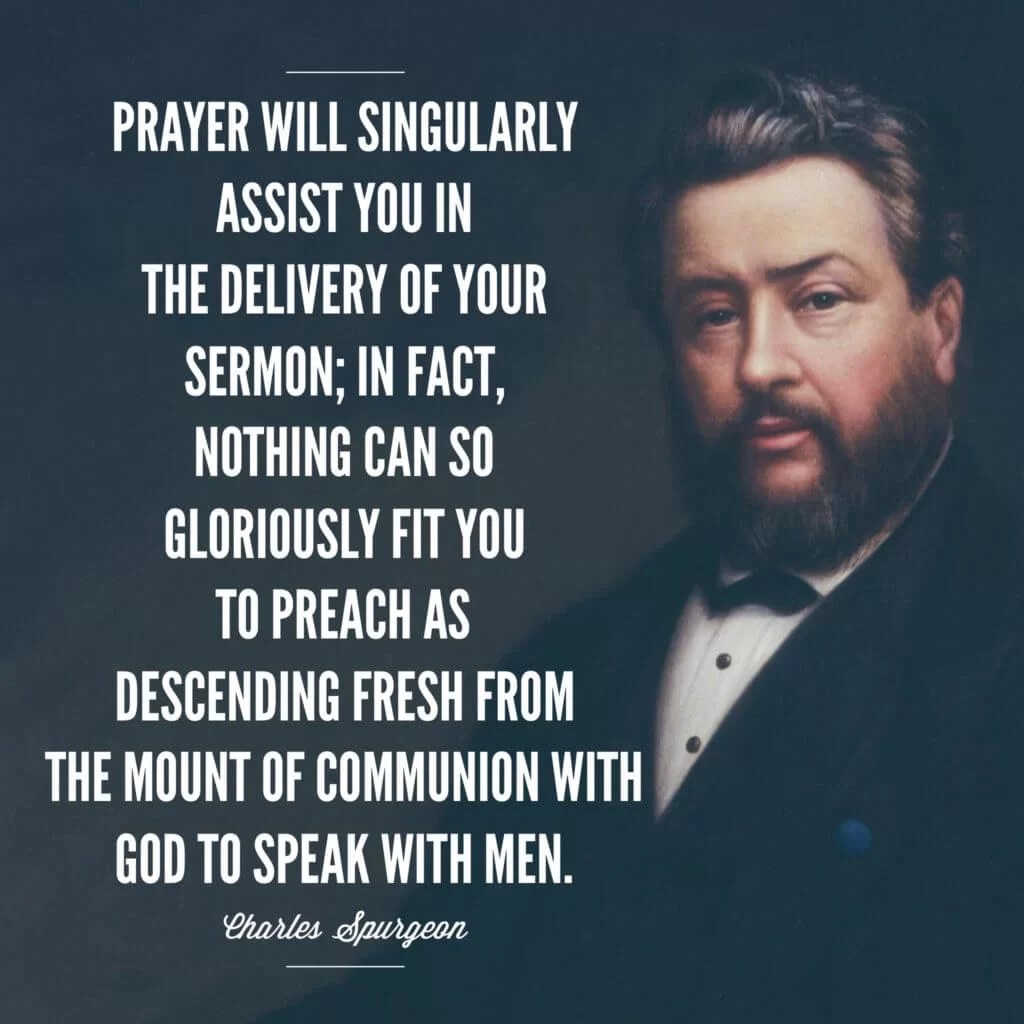
The great preacher of Victorian London was Charles Haddon Spurgeon. You might think of him as the Billy Graham of the 19th century. He began preaching at 19 and “quickly gained a reputation as an electrifying preacher. Spurgeon’s sermons were characterized by their passion, wit, and biblical depth, and he was able to connect with people from all walks of life” (quoting https://www.inspirationalchristians.org/reformers/charles-spurgeon-biography/).
Known as “the Prince of Preachers,” Spurgeon preached as many as ten times a week, and his sermon collection fills 63 volumes (!) making it the largest collection of books by a single Christian author. In fact, he preached some 600 sermons before the age of 20, and he developed such a strong voice, he once preached to a crowd of 23,000 with no microphone or sound system.
To this day, Spurgeon remains one of the most quoted, most talked-about preachers of the last two hundred years. While looking at commentaries on Psalm 130, I stumbled across an entire sermon Spurgeon preached in the summer of 1887. I read the sermon and can only imagine how striking it would have been to have heard it preached.
Spurgeon titled his sermon, “There is Forgiveness,”[1] and because he is such a famous preacher, a Calvinist-Baptist evangelist, I thought it would be useful to quote at length his discussion of Psalm 130:3-4. Here is that passage:
“If thou, Lord, shouldst mark iniquities, O Lord, who shall stand? But there is forgiveness with thee, that thou mayest be feared” Psalm 130:3-4.
And now some words excerpted from Spurgeon’s sermon on these verses:
“You have not sinned so greatly that you have exceeded God’s forgiveness. Thou hast not gone beyond his mercy; thou canst not go beyond his mercy if thou wilt trust his Son. “There is forgiveness” [Psalm 130:4]. Let this whisper drive away despair. What a blessed whisper it is! “There is forgiveness.” “There is forgiveness.” Let it enter thy soul, and drive those grim ogres and hobgoblins of despair away into the sea of forgetfulness. “There is forgiveness” …
“The law says, “The soul that sinneth, it shall die;” [Ezekiel 18:20] and the law knows no mercy, it cannot know any mercy. Sinai [symbolizing the given there] has never yet yielded one drop of water to cool the parched tongue of a guilty sinner. Never did a shower reach its craggy peaks; it is a fire-mountain, and the thunder rolls over its summit, with the sound of a trumpet loud and long, making all who hear it to tremble. God, when he comes to judgment, must judge according to justice; but— but— but— but there is forgiveness …
“There is another Law-giver besides Moses; there is Jesus the Son of God. There is another covenant besides the covenant of works, there is a covenant of rich, free, sovereign grace, and this is the essence of it, “There is forgiveness.”
Oh, that I could convey that whisper into the ear of every sinner who is here! I can do that; but oh, that God the Holy Ghost would put it into his heart, that he might never forget, “There is forgiveness”! …
“Turn to the Old Testament, and you will see that it reveals sacrifice,— lambs, and bullocks, and goats. What did they all mean? They meant that there was a way of pardon through the shedding of blood; they taught men this, that God would accept of certain sacrifices on their behalf. Then turn to the New Testament, and there you will see it revealed more clearly still that God has accepted a sacrifice, the sacrifice which he himself gave, for “he spared not his own Son, but delivered him up for us all” [Romans 8:32].
In this Book you read how he can be “just, and the Justifier of him that believeth” [Romans 3:26] … This, in fact, is the revelation of the gospel; this is what this Book was written to teach, to tell you that “God was in Christ reconciling the world unto himself” [2 Corinthians 5:19] …
“There is forgiveness” for you, though you think there is none. Your thoughts are not as God’s thoughts; neither are your ways as his ways [Isaiah 55:8]. … There is, there surely is, at this moment, forgiveness…
“Against thee, thee only, have I sinned,” [Psalm 51:4] but, “there is forgiveness with thee;” with the very God whom you have offended. It is with God in such a way that it is part of his nature. “He delighteth in mercy” [Micah 7:18]. “God is love” [1 John 4:8]. He glorifies himself by passing by transgression, iniquity, and sin. There is forgiveness with God; it is in God’s very nature that it lies. Fly not away, then, from the very place where forgiveness awaits thee…
“I feel somehow certain that I am going to have some souls [saved] to-night to be my reward. I love to ring those charming bells, “free grace and dying love.”[2] A great part of the pleasure of preaching is derived from the fact that I know that God’s Word will not return unto him void [Isaiah 55:11], but that some who hear the gospel message will receive it, and be saved. Listen to this word, thou doubting, trembling, despairing sinner, “there is forgiveness,” and that forgiveness is with God.
If I told you that it was with myself, and that I was the priest, perhaps you would be foolish enough to believe me; but I will tell you no such lie. It is not with any priest on earth, it is with the Lord. “There is forgiveness with thee;” and thou mayest go to God just as thou art, with nothing in thy hand, and cast thyself at his feet, quoting the name of his dear Son. Rest there, and the work is done; for, as God liveth, it is true, that there is forgiveness with him that he may be feared…
“There is forgiveness with thee, that thou mayest be feared…”
“… Somebody said, “I should have thought that it would have read, “that thou mayest be loved.” Yes, so I should have thought; but then, you see, fear, especially in the Old Testament, includes love. It includes every holy feeling of reverence, and worship, and obedience towards God. That is the Old Testament name for true religion— “the fear of God.”
“So I might say that the text declares, “There is forgiveness with thee, that thou mayest be loved, and worshipped, and served.” Still, even in the sense of fear, it is a most blessed fact that they who fear the Lord are delightful to him. “The Lord taketh pleasure in them that fear him, in those that hope in his mercy” [Psalm 147:11] …
“If you want to revive your fear of God, and have it deepened, believe in your pardon … There is forgiveness first, and then the fear comes afterwards. All the fear in the world that is worth having is the result of pardoned sin.”
Dear God, thank you for great men who serve You faithfully for decades like Charles Spurgeon. And thank you for this Old Testament message so relevant today: “There is forgiveness with thee, that thou mayest be feared.” Thank you for forgiving us! Fill us with gratitude over pardoned sin. Fill us with the holy fear of God. May we fear You, worship You, serve You, pray to You, and share You with others. Use us, Lord. Fill us with the joy of the Lord, the joy of serving You.
AΩ.
[1] https://www.spurgeon.org/resource-library/sermons/there-is-forgiveness/#flipbook/
[2] Free Grace and Dying Love was the title of a book of devotional readings by Susannah Spurgeon, wife of the famous preacher. https://www.amazon.com/Sussannah-Spurgeon-Morning-Devotions-Susannah/dp/0851519180
 Household Words: