David Lost the Moral High Ground.

Who was David’s greatest enemy?  Goliath?  King Saul?  The Philistines? How about Absalom? 

David’s own son staged a coup, taking his father’s throne and forcing David and his armies into the streets, running for their lives.  His son?  What happened?

David had children by so many wives that there were half-brothers and half-sisters all over the kingdom.  Amnon fell in love with his half-sister Tamar, raped her, then tossed her aside.  Tamar’s (full) brother Absalom waited for David to address the injustice.  But King David, though angry, did nothing.  Two years later, Absalom killed Amnon himself, a choice that set him on a path of rebellion against his father that grew into insurrection and eventually a usurpation of his father’s throne.  Absalom was ready to kill David and all his men. 

David ended up running for his life and composed Psalm 3 while in hiding, a fugitive from his own son.  Was Absalom then David’s greatest enemy? No.

David’s greatest enemy was himself. 

Following adultery with Bathsheba and the murder of Uriah, David lost the “MORAL HIGH GROUND.” 

He did not lose his sense of right and wrong. He did not even lose his relationship with God—he prayed through Psalm 51 and was restored to fellowship with God.

But David lost the “MORAL HIGH GROUND,” the ability to take decisive action against the sin of his children. 

When Amnon raped Tamar, David probably saw in Amnon his own sin with Bathsheba.  David sympathized, perhaps, with his son’s failure, and he lacked the WILL to execute justice.  David should have had Amnon put to death under the law, or if that was too much for him, he could have had him banished.  He should have done SOMETHING.  But he let the memory of his own sin rob him of the MORAL WILL to enforce the law.[1]


Sin weakens our resolve, and sometimes serious sin leaves us indifferent to true holiness—even after we have made things right with God.  It is simply difficult to expect others to make the good choices we failed to make ourselves. 

May we never sin so severely we lose the moral will to demand the best from ourselves and those around us.

ΑΩ

[1] King David likewise suffered from a Separation of Powers problem.  As king, David was the legislator who made laws, the executive/prosecutor who enforced laws, and the judge who decided cases.  When these three powers are combined in a single man, corruption follows.  Someone other than David should have tried and adjudicated the case against Amnon.  I have often written that this was Pontius Pilate’s problem: his concern at keeping the peace (a politician/legislator’s concern) caused him to fail as judge, allowing the trumped-up case against Jesus to proceed with neither a valid legal basis nor evidence to support the case.
Mercy.

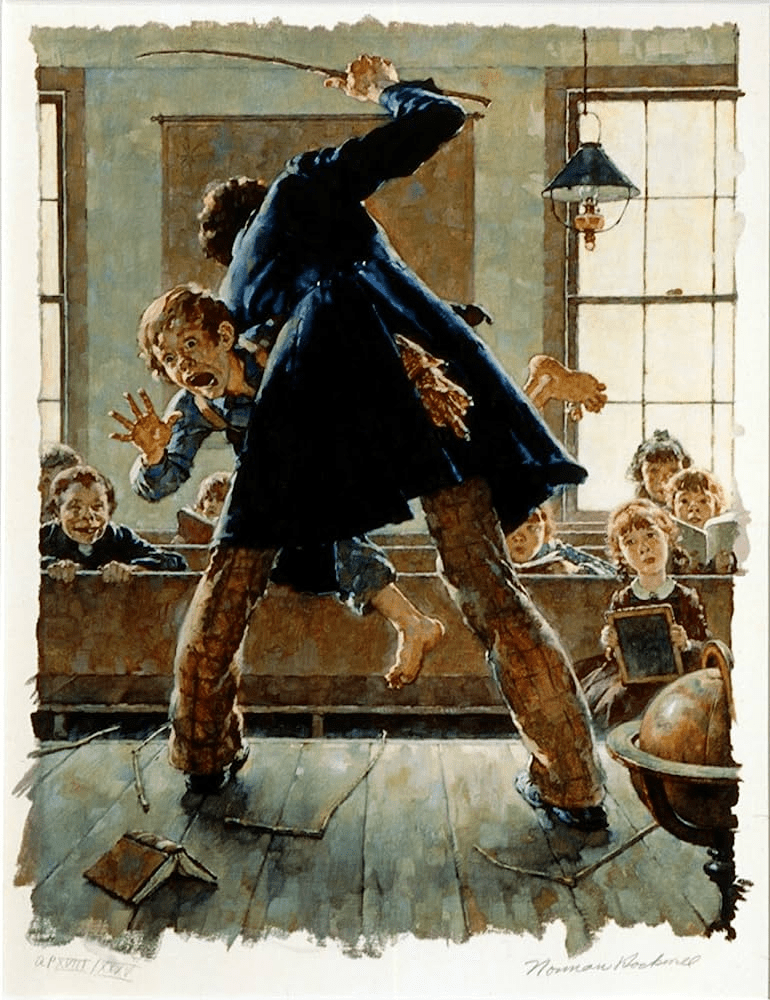
“Corporal” or “bodily” punishment is effective with children because it is painful.  There is also fearful anticipation associated with the instrument of punishment. In order of mildest to most severe, I would rank them: hand, wooden spoon, ruler, belt, tree branch/switch, the cricket-bat-style wooden paddle.  I feared my father’s belt—that was his most severe tool.  He feared his father’s razor strop, a heavy strap of leather more intimidating than any belt. That healthy fear created a healthy respect. 

I would argue the respectfulness of young men is in direct correlation to the use of appropriate discipline when deserved. That discipline should be predictable and consistent—rarely a surprise—and should come from a father who is otherwise tender and kind. Strong-willed boys will not grow into strong, self-disciplined men without the training of consistent discipline, sometimes including corporal punishment.  Girls need consistent discipline as well, though probably less corporal punishment.

Nevertheless, one of the most amazing things a tough disciplinarian can do is choose NOT to punish. A good parent should watch for that rare moment when circumstances and a child’s genuine remorse indicate the best thing to do is have a conversation that ends with MERCY rather than punishment.

When my dad set a hayfield on fire as a little boy, his father—after helping a dozen men put out the fire—sat his six-year-old down, talked a while, and explained why he was not punishing his terrified, regretful son.  Years later, Daddy had mercy on me several times.  And when private school suggested expelling my son, it was my turn to show MERCY.

He has not dealt with us as our sins deserve, or repaid us according to our offenses…  As far as the East is from the West, so far has He removed our transgressions from us.  AS A FATHER HAS COMPASSION ON HIS CHILDREN, so the Lord has compassion on those who fear Him. For HE KNOWS OUR FRAME. HE IS MINDFUL THAT WE ARE BUT DUST” Psalm 103:10,12-14.

Dear God, thank You that You know our limits, You know we are “but dust.” Thank you for your mercy!  Help us understand Your mercy and use us to share it with others.

ΑΩ

Jesus Was Shrewd.

He knows human nature. So when the Pharisees were in a frenzy to kill Him, He knew not to trust anyone. He understands what lurks in the heart of mankind.

“Now when He was in Jerusalem at the Passover, during the feast, many believed in His name, observing His signs which He was doing. But Jesus, on His part, was not willing to entrust Himself to them, for He knew all men, and He did not need anyone to testify concerning man, for He Himself knew what was in man.” John 2:23-25.

Does that make you feel bad? It should not.

You already know what is in your heart—Jesus does too. You cannot surprise Him. Haven’t we all let our own selves down many times and in many ways? He knows.

When Jesus sent out His disciples, He told them to be “shrewd as serpents, but innocent as doves.” You have to be careful whom you trust—though you must always be trustworthy.

And when you fail?

He is merciful. “For He knows our frame. He is mindful that we are but dust.” Psalm 103:14. God is merciful. He knows you will fail. He understands human nature. He is shrewd and savvy and He is not surprised.

So go to Him with your failures and sins. Confess. Repent. Ask for forgiveness.

“If we confess our sins, He is faithful and just to forgive us our sins and to cleanse us from all unrighteousness.” 1 John 1:9

Pray. Talk to God about your failures. Confess specifically. Thank Him that He understands human nature and is not surprised or shocked. Ask Him to help you do better. Ask Him to give you good ideas, tools, and strategies to do better.

ΑΩ

The Opposition Party.

Yesterday I read about a writer who said he was “the opposition party” in his family. Whatever Dad was for, this kid was against. I can relate to that. Sometimes I am against things just because they are popular, like Buc-ees. But growing up means using God’s wisdom to temper those attitudes—and I have learned to support many things I once rebelled against, like education.

Are you the opposition party? Do you fight things for no reason? Worse, do you fight God? David understood this—after all, EVERYONE rebels about something, bucking like an unbroken horse. Imagine if a farrier tried to treat Trigger’s hooves—it is so hard even to BLESS a horse that is wild. In Psalm 32, David compares a rebellious person to a horse with no training:

Do not be like a horse or mule, without understanding, that must be controlled with bit and bridle or else it will not come near you” Ps. 32:9.

Does God have to use a bit and bridle to get near you? Or will you come to Him on your own?

Are you indifferent? —Interested in God, but only now and then, and at other times He has to use bad circumstances to get your attention? Most of us are—we love God sometimes, and we fight God sometimes. Ask God to give you an undivided heart. Pray David’s words in Psalm 86:11:

Teach me Your way, Lord, and I will live by Your truth. Give me an undivided mind to fear Your Name” Ps. 86:11.

Pray. Dear God, calm my sometimes rebellious spirit. Help me to bring all my attitudes before You. I want to submit to you my feelings, my opinions, my anger and frustration about lockdowns, and every other issue. Please control my emotions and give me wisdom to have the right beliefs and opinions and feelings. I submit myself to You and to Your Word—in every area. Show me where my views are wrong, and help me to change them. Make me more like You.

ΑΩ

God Does Not Change.

Have you heard people say that God is full of wrath in the Old Testament but forgiving in the New?  God says He does not change:

I am the Lord and I do not change” Malachi 3:6.  (See also Hebrews 13:8.)

If God does not change, where is the Old Testament grace? 

If you search for it, you will begin to find His grace throughout the Old Testament.  One of my favorite examples is David’s Psalm 103.

He FORGIVES your sin. He heals all your diseases. He redeems your life from the pit … He has not dealt with us as our sins deserve or repaid us according to our offenses … As far as THE EAST IS FROM THE WEST, SO FAR HAS HE REMOVED OUR TRANSGRESSIONS FROM US.  For He is mindful that we are but dust” Psalm 103:3-4,10,12,14.

The nation of Israel peaked with King David on the throne.  They won dozens of battles, took control of more territory, and created a sophisticated government and culture.  The nation had copies of God’s law and had priests to teach it.  David knew the law and would have made his own copy by hand according to Deuteronomy 17:18-19.  If ever there was a time to believe God’s law would save you, this was that time. 

Yet David understood that only God could cleanse his sin.  Moreover, David believed by faith that God WOULD cleanse him, removing his sin as far from him as the east is from the west.

The message of the two Testaments is consistent: we fear God, we honor Him as holy and we honor His law. But we confess that we are unable to obey it perfectly, that all we like sheep have gone astray.  We are stained with sin and only God’s grace can make us holy.  By faith we believe that God will make us holy and restore our broken lives with a new purpose—serving Him.

Let me challenge you: READ THE OLD TESTAMENT LOOKING FOR GRACE ON EVERY PAGE.

ΑΩ

Sin Sickens. It Festers.

Cat fights result in bites and scratches filled with germs. But cat skin heals quickly—sometimes faster than the underlying infection—creating an abscess.  To heal it, the vet will drain it. In serious cases the vet will stitch a piece of plastic in place to hold the wound open, ensuring the fluid continues to drain.  Abscesses kill; an abscess killed Dutch.

Sin is the same. It festers.

When I kept silent about my sin, my body wasted away, my bones became brittle. I groaned all day long. Day and night Your hand was heavy on me. My strength was drained as in the fever heat of summer” Psalm 32:3-4.

When you ignore sin, it festers like bacteria under the skin. And because of the mind-body connection, hidden sin will damage your health.  David says his bones became brittle, he groaned all day long, and God’s hand was heavy on him.  Even his strength was drained as if he had worked all day in the summer’s heat.  In both Psalm 32 and Psalm 51, David speaks of broken and crushed bones.  Killing Uriah and having an affair with Bathsheba left David so broken, so INFECTED, he groaned as if his bones were crushed and broken.

Sin sickens.  Many sins directly cause illness. Alcohol causes cirrhosis of the liver. Smoking causes lung cancer. Gluttony causes obesity. STDs (the CDC says “there are DOZENS of STDs”) cause numerous genitourinary conditions, resulting in infertility, mental problems, heart disease, blindness, liver cancer, and death. But all sins have consequences. Lying and stealing, and other sins that may not directly cause illnesses will nevertheless adversely affect your health because they increase guilt, stress, and anxiety. 

God can forgive and restore.  After David confessed his sin with Bathsheba, he discovered the joy of being forgiven:

“How joyful is the man whose transgression is forgiven, whose sin is covered!” Psalm 32:1.

God, never let us hide sin in our hearts. Remind us to come to you and confess sin daily. Heal us. As David prayed in Psalm 51, ‘Let the bones which Thou hast broken rejoice.’

ΑΩ

How Do You Get Clean?

When a child soils a diaper, who cleans him? Can a baby clean himself? When toddlers cover each other with ink or peanut butter or shaving cream or flour (see YouTube), do the parents tell them to clean it up? No. Children are terrible at cleaning up. Mom and Dad have to do it, or it will only get worse.

We are the same way. Humans are great at making messes, but terrible at cleaning up. God has to do it, or it will only get worse. Only God can truly clean you.

King David understood that. He makes that clear in two psalms, both of which were written after he murdered Uriah and stole his wife, Bathsheba.

In Psalm 32 he says, “When I kept silent about my sin, my bones became brittle, my strength was drained, Your hand was heavy upon me. But when I confessed, You took away my guilt.” Psalm 32:3-5.

But Psalm 51 is the real star. Read it. It may be the BEST prayer for a guilty heart. Your mom and I have memorized much of it:

Be gracious to me, O God.… According to the greatness of Your compassion, blot out my transgressions. Wash me thoroughly from my iniquity and cleanse me from my sin…. Against You, and You only have I sinned, and done what is evil in Your sight, so that You are justified when you judge me…. Purify me and I shall be clean; wash me and I shall be whiter than snow. Give me joy again. Let the bones You have broken rejoice again. Blot out my iniquities. Create in my a clean heart, O God, and renew a right spirit within me…. Restore to me the joy of my salvation. You do not delight in sacrifices and burnt offerings… The sacrifices of God are a broken spirit, a broken and contrite heart, O God, You will not despise…

Read Psalm 51 and talk to God about your sin. It is a beautiful piece of worship.

ΑΩ

Speak Grace.

God saw everything.  Then He sent a prophet to condemn Mr. Sinner. Consequences followed:  Mr. Sinner’s child became ill and died.  Then a son of Mr. Sinner raped his half-sister who was the daughter of Mr. Sinner. Then another son killed the rapist brother. Mr. Sinner banished the avenging son. Later, Banished Son attacked Mr. Sinner’s kingdom, launching a revolution.  Mr. Sinner ran for his life.  Then Mr. Sinner’s wives were publicly ‘taken’ by the rebel son. The civil war raged on and when it ended, some 20,000 were dead, including Mr. Sinner’s son who began the whole thing—and whom he loved very much.

Mr. Sinner is David, of course.  God saw him steal the wife of Uriah, get her pregnant, then send Uriah into battle to be “murdered by the Ammonite’s sword,” as Nathan described it in 2 Samuel 12:9. David committed adultery and murder. 

God saw it all, and God punished David severely, promising “the sword will never leave your house because you despised Me and took the wife of Uriah the Hittite to be your own wife.”

David immediately repented. Psalm 51 is his raw statement of grief over his sin. Its honesty and emotion makes it a treasure among Biblical literature.

But God is the hero of this story. His forgiveness is IMMEDIATE: 

David responded to Nathan, “I have sinned against the Lord.”  Then Nathan replied to David, “The Lord has taken away your sin. You will not die.” 2 Samuel 12:13-14.

But even more significant—God chose to continue the royal line through Solomon.  Who was Solomon’s mother?  Bathsheba.  God chose the son of Bathsheba. Though David had some 700 other wives, it was through the line of Bathsheba that the Messiah would come.

Think about that—Jesus is descended from David and the woman with whom David nearly destroyed his kingdom and even his life. Notwithstanding the ‘origin story’ of adultery and murder, God was gracious. God never saw Solomon as ‘less than.’

God, help us speak truth like Nathan… but also speak grace like Nathan. Help us see people the way You see them.

ΑΩ

What Happens When You Die?

Christians believe in Heaven and Hell—two destinations. If you trust yourself for goodness, you’ll never be good enough, and Hell is your destiny. But if you humble yourself and rely on Jesus, He can make you holy, and death is the door into Heaven. 

But did they understand that in the Old Testament?

Yes. 

When God struck down David’s infant son, David accepted that and told his men: “I’ll go to him, but he will never return to me.” 2 Samuel 12:23.

Do you feel sorry for that child? Don’t. He got an early pass to Heaven; he was bumped to the front of the line. Most people endure 80 years of struggles, but not him.

The book of Job says something similar. When Job lost everything, God restored to him double:

7,000 sheep were replaced with 14,000.

3,000 camels became 6,000.

500 teams of oxen became 1,000.

500 donkeys became 1,000.

But when he lost 7 sons and 3 daughters, God replaced them with only 7 sons and 3 daughters. Why? Because the first 10 kids were NOT taken from Job, but merely moved over to Heaven. They still exist! So Job has TWENTY living children, some living on earth, some in Heaven.

As Jesus said, “He is not the God of the dead but of the living!” Mark 12:27.

Have you lost anyone to death? Talk to God and thank Him that they are not really dead at all, but ALIVE in heaven, in fact, they are more alive there than they ever were on earth. Praise God! 

ΑΩ

Confession is Good for the Soul.

When I was a Boy Scout we took long hikes with loaded, external-framed backpacks.  A six-mile walk with a heavy pack is tough—and the hardest part is setting off again after a break.  Shouldering a heavy pack the second time is harder than the first.

When we sin we carry the weight on our soul like a backpack full of water bottles.  Sometimes guilt is particularly heavy for believers.  Once you have had the guilt lifted at salvation, taking up the load again later feels harder than before.  The answer?  CONFESSION.  When David committed adultery with Bathsheba and murdered Uriah, he could not escape the guilt.  For months he said nothing—and it consumed him:

When I kept silent about my sin, my body wasted away through my groaning all day long.  Day and night Your hand was heavy upon me. My vitality drained away” Psalm 32:3-4.

David was miserable until he confessed.  Have you carried guilt like a terrible secret? Confess your sins to the Lord.  That is the only way to lift the weight that cripples you.  Pray the words of Psalm 51—the psalm David wrote when he finally confessed:

Be gracious to me, oh God, because of Your faithfulness, according to the greatness of Your compassion, wipe out my wrongdoing. Wash me thoroughly from my guilt and cleanse me from my sin … Against You and You only have I sinned and done what is evil in Your sight, so that Thou art justified when You speak and blameless when You judge … Wash me and I will be whiter than snow … Create in me a clean heart, God, and renew a steadfast spirit within me” Psalm 51:1-10.

Are you depressed or trapped in addiction?  Do your prayers seem to reach the ceiling and go no further? If God feels distant, confession may be the answer.  Pray the words of Psalm 51 over and over and talk to God about your sin as specifically as possible.  Confession the first step to removing the weight from your shoulders.

ΑΩ