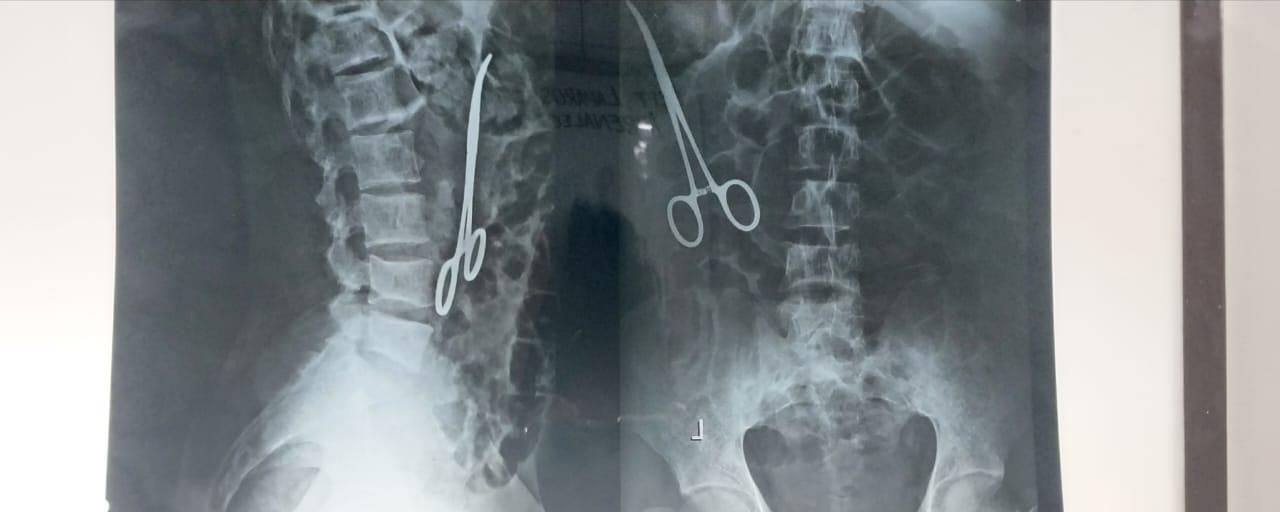
Job’s friends have a Res Ipsa Loquitor view of suffering. Res ipsa loquitor is Latin for “the thing speaks for itself.” This is a lawyer’s argument to prove negligence when traditional evidence may be lacking. For example, if an X-ray reveals a pair of forceps left inside a patient following surgery, the mere presence of the forceps is proof of negligence. There is no need for videotaped evidence of a surgeon closing an incision while leaving surgical tools behind. The presence of forceps alone is proof of negligence. Job’s friends have a res ipsa view of suffering. Let me explain.
Job’s friends believe that good people will be rewarded with good times and bad people will be rewarded with bad times. Children think this way. When a child works hard at something, but it turns out badly, what do they say?
“It’s not FAIR!”
And it’s not just children. Adults think this way too—and we should, to some extent. We live in a world in which people reap what they sow. USUALLY. But just as a farmer may sow a good seed and cultivate it all season long, sometimes he will reap only weeds and thistles. Or the ground may yield beautiful plants, only to see them destroyed during a ten-minute hailstorm. Sometimes good people suffer terrible things. And sometimes bad people enjoy years of wealth and privilege.
The black-and-white view of sowing and reaping is like a pair of simple math equations:
good choices + time = prosperity.
bad choices + time = poverty.
Job’s friend Zophar would agree with these equations. When Zophar sees all the terrible things that have happened to Job, he assumes Job is hiding sin in his heart. And Zophar is not simply being judgmental. In fact, Zophar might argue he is practicing an early form of apologetics: Zophar is using reason to defend God.
Like Job, Job’s friends love God, and the miserable destruction of Job’s life presents a difficult challenge to their belief in a good and just God.
Zophar is trying to defend God’s honor. To Zophar, the notion of a good God that would allow so much suffering in an innocent man’s life is sacrilegious. Zophar, along with Bildad and Eliphaz, believes God is good, therefore Job must have done something terrible to cause God to take away Job’s children, his health, and all his possessions.
Zophar concludes that his old friend Job must be wicked. Zophar then proceeds to describe the wicked by saying he will be sick and suffer: “his meat in his bowels is turned, it is the gall of asps within him. He hath swallowed down riches, and he shall vomit them up again” Job 20:14-15. Zophar assumes the wicked—and by implication, Job—has oppressed the poor (v.19) and now he will be destroyed “the bow of steel shall strike him through” Job 20:24. Zophar, like his two friends, assumes that the mere presence of suffering in Job’s life is proof of Job’s guilt.
The three take a ‘RES IPSA LOQUITOR’ view of suffering: the presence of suffering is proof of sin.
Naturally, Job does not agree. I suspect he might have agreed a few weeks earlier—before all these horrible things happened to him. But he certainly does not agree now. Job disagrees for one simple reason: he knows he has not done anything as sinful as the wickedness his friends describe. Job responds to Zophar by talking about how wonderful the lives of the wicked can be. (And he’s right, isn’t he?)
“Why do the wicked live, become old, are mighty in power? Their seed is established in their sight with them, and their offspring before their eyes. Their houses are safe from fear, neither is the rod of God upon them. [Their bulls and cows have healthy calves, and the wicked parents have healthy children] … They spend their days in wealth” Job 21:7-13.
As you probably know, God later vindicated Job. He showed up and told Job’s three friends “Ye have not spoken of me the thing that is right” Job 42:7.
We must not distort the Biblical principle of sowing and reaping.
The Bible says, “whatsoever a man sows, that shall he also reap” Galatians 6:7. If you work hard in school, you will make good grades. If you work hard at the gym, you will grow stronger. But sometimes the hard-working student will suffer a circumstance leaving him with a bad grade. Likewise, the gym rat may sprain his ankle walking to the car and be forced to drop out of the Ironman competition he was anticipating.
When it comes to suffering and prosperity, nothing is ever black and white. There is no res ipsa loquitor argument that can prove righteousness or wickedness. The innocent will suffer and the guilty will enjoy prosperity and all we can do is trust God and walk by faith. He is sovereign and his ways are higher than our ways.
“Oh, the depth of riches of both the wisdom and knowledge of God. How unsearchable are his judgments and unfathomable his ways” Romans 11:33.
Dear God, thank you for the truth of your Word! Not only Job, but Ecclesiastes and many others who speak truths that every skeptic already knows: yes, we suffer! Thank you for writers who admit that yes, the wicked seem to have great lives, and yes, sometimes the righteous suffer so much! Thank you for the peace and the grace and the simple satisfaction that comes from knowing that we are not crazy, but that yes, things can seem mixed up and backwards and life is not always fair. But you are sovereign. And you are on your throne. And you love us.
And as Job said, “I know that my redeemer liveth, and in the end, he will stand upon the earth, and after my skin has been destroyed, yet in my flesh I will see God! With my own eyes, I will see him! How my heart yearns within me” Job 19:25-27. Yes, Lord. Our hearts yearn to see you! Thank you for your love and compassion. Thank you that no matter what we suffer, you are always with us. You are a good, good father!
AΩ





 Household Words: