(After posting some 1,200 Bible studies and/or devotionals, this is the first that is simply a personal narrative. A true story/ memoir. Yes, it makes a nice story about David’s Psalm 8. But it’s a story. Posted here for fun.)
I was a father myself when Mama hit me with serious questions about my father, her husband of fifty years:
“Is the writer saying everyone is wounded by their fathers? Do you think you have a father wound? What could your father have done differently? And if you are wounded, is there anything we can do to help?”
After I read it, I had loaned my mother a copy of the excellent book, WILD AT HEART. John Eldredge writes with creativity and insight about men, and fathers, and movies, and literature—I have loved all his books for their insight, and for a “unifying theory” of literature that appealed to this English major. But Mama was wondering if regrets were in order. Her father had died when she was ten—that leaves a solid father wound, but not one with much blame attached.
I laughed at her concern and collected my thoughts. My experience reading John Eldredge was not unlike my brother’s experience in medical school: you read about a new disease and then realize that of course, you also have all the symptoms: you’ll be gone in a matter of days. I had given this “father wound” a lot of thought. I smiled at my mom.
“If I have a father wound, I haven’t found it.”
I was serious. I had looked. My relationship with my father had been colorful, filled with highs and lows, but never so low that I doubted his love or loyalty. When your father is a man of such integrity that he refuses to open mail addressed to his wife, it’s impossible to imagine him failing his family—until he does. Mine never did.
Ernie Wales taught Sunday school some forty-odd years, to boys ranging from seventh-graders to college students. Years later I taught alongside him. But when I had the chance to sit in my father’s class as a student, I bailed out.
I figured I’d seen the Ernie movie: left-brained engineer marches through an outline point-by-point. It was the way he had been talking to my brother and me all our lives, about the difference between volts, watts, and amperage, about the speed of sound versus the speed of light, about the principle of lift, about the internal combustion engine, about his work designing tape drives and memory chips, and the patent he had on the wall to prove it. Most of these topics I’d mastered only enough to know they were boring—boring and a little beyond me, though I listened harder to him than I ever did at school.
I wanted something creative, and I liked teachers who would give up on an outline if they began losing their audience. Daddy did not have a give-up bone in his body: he would reach the end of his lesson and plant a flag there, Sir Edmund Hillary scaling Mount Everest. I was the same way—I found it difficult to give up on things, and the two of us clashed like Bighorn sheep. But I had given up entirely on one thing: school in general and algebra in specific. I think that defeat, that failure of the will, upset him more than the hundreds of fights we had about stupid and trivial things I refused to surrender.
My apathy about school would turn out to be temporary: one day I would tackle my classes with a confidence and a work ethic I could only have learned from my parents. But that day was a long way off, and impossible to imagine.
Meanwhile, I knew I was not really avoiding carefully constructed Sunday school lessons. I avoided my father’s class because I did not want to be embarrassed. I did not want to witness those awkward moments, moments like his visit to my sixth-grade class at Ed White Elementary. He entered the room that day in western boots and a leather sport coat and looked like James Garner on The Rockford Files. When he came in and smiled his tall-dark-and-handsome smile, I felt my estimation rise in the eyes of the female students. They looked at him and then they looked at me, and seemed to be thinking: maybe there’s hope for Steven after all. Even better, Roderick Simpson, one of the most amazing athletes I would ever know, turned to me with eyes like saucers:
“Wow! Your dad is tall! You are going to be tall when you grow up!” I was proud.
My father was there to tell us about drilling for oil through the permafrost in Russia. Although he had been all over the world, I knew he had not been to Russia. But he brought one of his coworker’s photo albums and sat down and pointed at the pictures while he spoke.
He did well: the expert provided great testimony on direct, and had excellent answers to the questions on cross. He knew the material. But when he held up the large photo album balanced across his knees, he folded his hand into a loose fist, and extended only one finger to point at the pictures: his middle finger. There seemed to be a thousand pictures in that album—and this man who never cussed gave the digital insult to every one. My classmates giggled and snickered, and he did not realize what had them so amused.
But I realized it, and I let it embarrass me. I didn’t care which finger he pointed with—I thought that was stupid. But I was embarrassed by what I perceived as his failure to be aware of his audience. I have long considered audience-awareness the number-one rule for any public speaker. I think I reached that conclusion on the day of the permafrost lecture.
When I was 16, I knew who Dave Richards was. But he did not really know me. I was an awkward sophomore of about five foot, six. At 140 pounds, my more encouraging friends said I was as muscular as a broom stick. Worse, I still had the face of a twelve-year-old. Dave Richards had the face of a man. He was a junior at least six feet tall and well over 200 pounds. He had a strong jaw, a broad smile, and reminded me of Fred Dryer, the football pro starring as a cop on TV’s Hunter. Dave played football and anything else he wanted to. Sports came easily to Dave. Everything came easily to Dave. In fact, Dave was even smarter than he was athletic.
I knew Dave was one of four boys that my father had taught in Sunday school two years earlier. They went to four different high schools, and each of the four would go on to be the valedictorian of his class. (Can you imagine a class of only valedictorians?) The smart boys had always gravitated toward Ernie: Daddy was a physicist and had sort of this MacGyver resourcefulness about him: he looked at things in unique, creative ways, and loved to solve puzzles of every kind. I knew his class would be regimented and artless (he was an engineer, after all), but I also knew Daddy would never fail to teach the boys some things they did not know. Dave had enjoyed it enough to stick around.
But that had no bearing on how Dave treated me:
Hey, man, where’d you get that jacket, Goodwill?
Hey, dingus, don’t you know how to tie a tie? That knot’s too tight.
Hey, dingleberry, why don’t you run a comb through that hair?
Our church youth choir was on a tour of Spain and Italy. Dave and I both sang bass. For two years, I had been hiding in the bass section with my fingers crossed, willing myself to finally get that growth spurt, some whiskers, and a deeper voice. My voice had finally begun to change. For the first time, I was truly singing bass, and could not avoid Dave. I tried to keep Scott Lyons or someone older between us. Scott could read music and play several instruments, and I sang harmony parts better when I stood next to him. But more importantly, the older guys looked out for me. But I was just close enough to Dave’s age that my presence bugged him like a tagalong little brother.
Hey, jerk, put away that crap so someone can sit there. This is a bus, not your bedroom.
Hey, doofus, get over there and help the man with the luggage. What’s wrong with you?
Hey, douchebag, why do you keep staring off into space with your mouth hanging open? You look like a retard.
I answered Dave. He was not going to hit me. So I defended myself:
That’s Tim’s stuff. I’m saving the seat for him.
I can’t help with the luggage—the bus driver just told everyone to back off and let him do it.
I’m looking out the window at the fictional world of Don Quixote [quoting the tour guide]. What do you expect me to do? We’ve been on this bus for hours.
If my answers were stupid, Dave would insult me again. If they were not, he would chuckle as if it had all been a friendly joke. Usually, I got the chuckle. I was small and skinny and I always said the wrong thing, but I was not as stupid as Dave thought I was. Usually….
One morning during the final week of our trip, I stepped into a pastry shop in Rome. I was looking for something like a donut, something that might be good for breakfast. We were tired, fatigued even, by the continental breakfasts served at every hotel: tasteless, colorless meals whose most interesting ingredient was often a roll as round and hard as a baseball.
(Every boy among us had thrown at least one roll, some by saving them to use in a game outside, others by simply tossing them around the hotel dining rooms, un-caught rolls skidding across white linen tablecloths and bouncing off sweating glasses of ice water and orange juice. Pretty girls had been duly tormented.)
Once inside the bakery, I quickly bought four tiny pastries without bothering about the English translation of the ingredients. They were pastries and I was not finicky. What could go wrong?
After I got back on the bus Dave asked to see what I had chosen. I unrolled the top of the sack. It was made of waxy, white paper. I pulled out the first sugary, creamy pastry, and held it between my thumb and index finger. Dave asked me what the pastries were called.
“Rum cakes.”
“Rum cakes?” He laughed. “You idiot. Do you even know what that is?”
“I’m about to find out.” I popped it in my mouth.
Dave smiled while I chewed.
“It’s rum, dingus. You know, alcohol? Man, how can you be so clueless? You’re on a church mission trip, and you brought rum cakes on the bus?”
I swallowed the first one. It was soaked in rum. I had smelled alcohol before, but never tasted it. I didn’t like it. I didn’t like it in this sweet, sugary form either. What a way to ruin a good pastry. The dough was dripping like a boozy tres leches.
Dave was smiling, enjoying this. He pointed out the adults climbing back on the bus. “You better hurry up and eat the rest—better not let them see you.” I ate the other three. I was not going to waste my money. Dave was cracking up, and kept calling me dingus:
“How many Lira did you pay for that, dingus?”
For the next few days, Dave could not stop laughing about the rum cakes. I wanted to argue some kind of logic with him. After all, it was not as though my rum cake faux paux was the only Innocents Abroad story on this trip. An entire Baptist youth group had just lost a measure of its collective innocence on one of the world’s most beautiful beaches, a beach you should not miss if you grew up making your sand castles in the brown sugar of Galveston, Texas.
La Granadella Beach was nestled in a hillside cove, with water clear as glass, and a rocky bottom some thirty feet deep. I will never forget staring into the depths from a rented peddle-boat, overwhelmed by the beauty and desperately wishing I had a mask and snorkel.
The water was amazing. But it would be the beach our youth group would remember, a Mediterranean paradise teeming with swarthy women, women whose prolific underarm hair was only a minor distraction from the fact that yes, they were indeed topless. Hundreds of women of every shape and size and age. It was like a blow to the head: painful and stunning and you’re dizzy, seeing stars. To add insult to injury, I had a classic awkward sophomore moment that morning, as I walked alone toward the peddle-boats, where I was to meet two girls. (But I was alone just then. Just my luck.)
In the distance, and through the shimmering heat, I saw about six women walking along the water’s edge in my direction. Before I recognized them, I knew they were part of our group because each wore a one-piece swimsuit, extraordinarily modest under the circumstances.
As they got closer, a few more facts became apparent: five of them were sophomores like me, the sixth an adult mother and chaperone. Mrs. W. had a loose shirt on over her bathing suit as a cover-up. All six wore sunglasses. They had footwear and small purses. Naturally: these five girls had been my grade’s beautiful, popular pack for years. They had beach clothes, sunglasses, purses, bling.
I had faded swim trunks. I was barefooted, without sunglasses, with wet, windblown hair full of sand and salt, and instead of a shirt, I was (ironically) topless. But I was sporting my Ethiopian six-pack—six muscles nicely framed by ribs. Years surrounded by teenagers had taught me to keep my skinnier assets covered: those being … all of them. But I was obsessed with this beach and this water; covering up was pointless, and in my quest to explore the ocean, I knew if I wore shoes, shirt, and glasses, I would lose shoes, shirt, and glasses.
Still, the closer the girls got, the more exposed I felt. When we were close enough to speak, I thought I would just smile and nod. Few things could be more difficult than talking to the Fab Five alone. In swim trunks. On a topless beach. Nothing awkward about that.
As the girls approached, I smiled and nodded. Five of them said hi to me by name. So far so good. I was nearly past them.
“Oh, Steven. We’ve been talking.” It was Mrs. W. Oh no. “We would love to hear your opinion.” Mrs. W. was always so nice; I had to be polite.
“Sure.”
“What do you think about all this—” and she gestured toward the women on the beach. Uh oh.
“You mean—?” I couldn’t finish.
“Yeah. What do you think about all these women going topless?”
She was asking my opinion? Here? Now? In front of the Fab Five? I’m sixteen years old, a sheltered kid from Texas. I’m surrounded by… I might never forget this day. Was she asking whether the adults made the right decision in bringing us here? I mean, it’s an amazing beach, but…
I stared at the six ladies in front of me. It was a complicated question and I needed a quick exit. We could talk about this on the bus one day. I would wear something nice, maybe some jeans and my knock-off jacket from “MEMBERS NAVY.”
“Well—”
I put on my most grown-up voice. It was the voice of my father—a Southern gentleman who had Mark Twain’s ability to diffuse awkward tension with a single line of homespun wisdom. I hoped it would work for me:
“Well, after a while, they all kinda’ look alike, you know?”
The girls laughed, not as embarrassed as I was. Mrs. W. smiled at them and they nodded and everyone seemed content. My statement was a half-truth at best, but it satisfied them, and we separated. We did not discuss it again. I suppose it is a complicated question: you’ve come all the way to Spain, and the beach is a wonder of nature that simply must be seen, but these kids are Americans, a church group, teenagers—half of them BOY teenagers: innocents abroad. It is an interesting question.
We still talk about the topless beach thirty years later. But no one talks about the crystal-clear water or the peddle-boats. But to Dave Richards, not even a thousand topless women could compete with my rum cake purchase. It was the funniest thing he had ever seen. During our days in Rome and Florence, he told everyone who would listen.
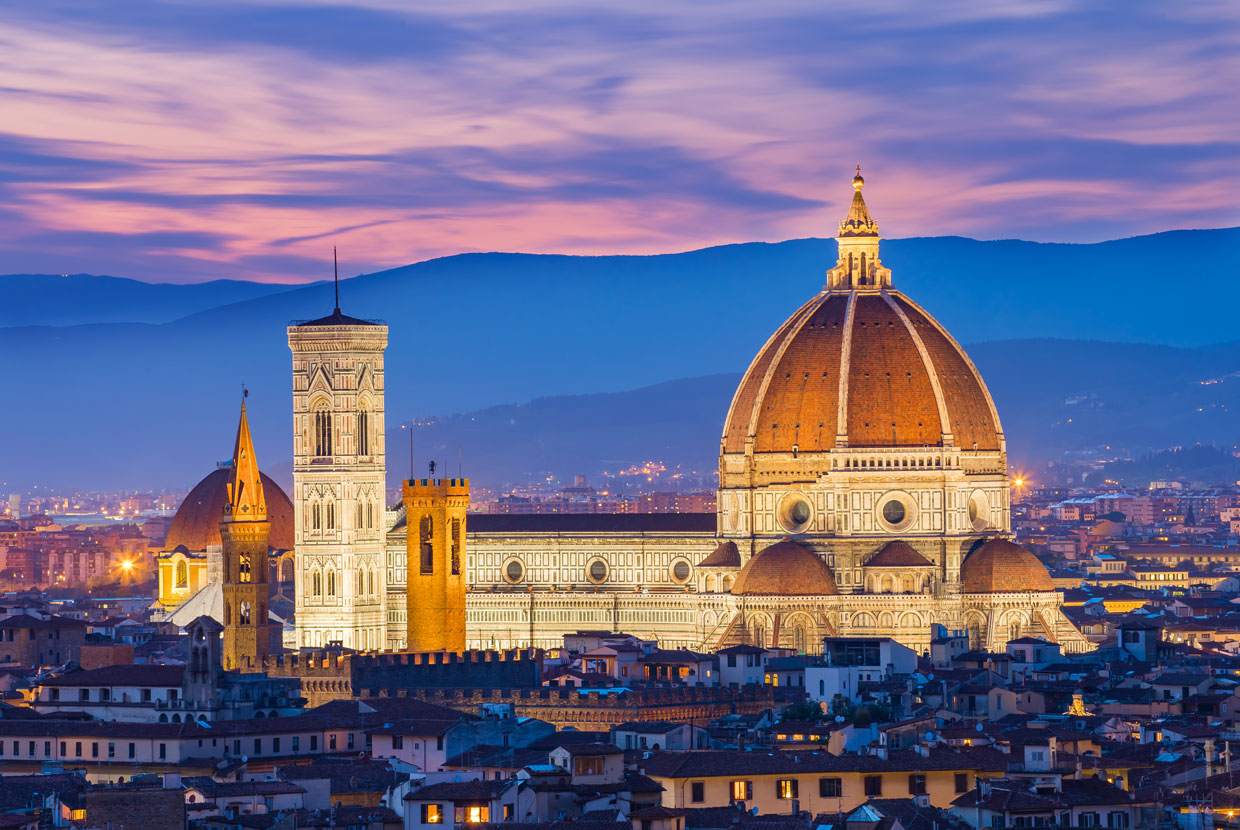
One night, the choir was scheduled to sing in the Florence Cathedral, home to some of the most amazing acoustics any of us would ever hear. That afternoon we mounted a set of risers for a quick rehearsal. After two weeks in Europe, there was not a boorish American teenager in our group who could not appreciate the acoustic perfection of a good choir singing choral music in a cathedral.
The amazing sound arrested even the most immature among us—at least for a few minutes. And the ultimate marriage of musical content and cathedral context had to be THE MAJESTY AND GLORY OF YOUR NAME, Tom Fetke’s arrangement of Psalm 8. The sheet music includes the English instruction that it be performed “With Wonder.”
The music begins with a simple piano part, then a soprano line, light and ethereal. Then comes four-part SATB, and the music grows and swells patiently. An organ joins. Slowly the harmonies become more intricate, parts layered one on top of another almost like a round.
Finally, it swells and broadens, a wide river of eight-part harmony, each of the parts floating hundreds of feet up to the cathedral ceiling and blending and re-arranging before floating back down to settle on the room, human voices gilded with echoes of the angels. Thus, those gathered in the ancient nave were touched by a musical experience no one outside a cathedral would ever hear. Only a cathedral can do that.
We had been moved by this song daily, in some half-dozen of Europe’s most-storied cathedrals. But today no one was singing yet, and as the line of us slowly took our places on the risers, Dave had just enough time to tell his favorite story again. He turned to the guy behind him, a short college guy named Robert. Robert had a mustache and did not suffer fools.
“Did you hear what this dingus did?,” Dave asked, laughing already.
Robert frowned at Dave.
“Who?”
“This guy—what’s your name, is it Steven?”
“Yeah.”
“Steven what?,” Dave asked.
I looked at him thinking don’t you know? I answered him.
“Wales.”
“Wales, yeah.”
He turned to resume his story. Then he paused, and looked back at me, still laughing at the story he was about to tell. But he had a thought:
“Hey! You any relation to Ernie Wales?”
“I’m his son.”
The Bible does not describe the look on the face of Saul of Tarsus when Jesus appears to him on the Damascus Road. But I think it was something like the look I saw on the face of Dave Richards. When I told him Ernie Wales was my father, Dave saw the light: suddenly a light from heaven shone around him. He looked at me and a flash of fear and dread crossed his face.
Of course, he was not afraid of his former Sunday school teacher. He was afraid that he had failed. Afraid he had crossed a line he never intended to cross. All humor was gone from Dave’s face. He was instantly as sober as a judge, and at least as pale. Dave, whose fair skin was often flushed by pink cheeks, suddenly looked like Hamlet after he hears the voice of his father’s ghost. I watched the blood drain from his face. His pink cheeks turned hollow and his skin became more green than rosy. He looked ill. He forgot the rum cakes completely and Robert never heard the story.
Dave stared at me, stunned. I could see him concentrating. Thinking. Wheels were turning, like the tumblers inside a lock: click, click, click. Finally, all the pieces fell into place and Dave spoke again, as if waking from a dream.
“Ernie Wales is your dad?”
“Yeah.”
“Are you serious?”
“Of course.”
“Why didn’t you tell me?”
“I thought you knew.”
Dave put out his hand, to shake mine, as if we had never spoken before.
“So you’re the son of Ernie Wales, huh? Nice to meet you. I’m David Richards.”
I shook his hand.
“Steven Wales.”
“Your dad was my Sunday school teacher. Man, your dad is awesome. Your dad is cool.” Dave laughed to himself, shaking his head. “Man, I love your dad. Your father’s a smart man.”
“Yep.”
“So why didn’t you tell me? You should have told me.” And then Dave put his hand on my shoulder and gestured. “Here, stand next to me.” Dave was on the back row, with the tall guys.
“But I’m—”
“Who cares? You’re tall enough. Jump in here.”
And the piano began its simple, quiet tune. And the girls sang, their voices floating upward as cool and weightless as moonlight:
“When I gaze into the night skies, and see the work of Thy fingers….”
When the song ended, there was applause from tourists escaping the oppressive heat and the world’s most aggressive pigeons. Most of the people had been outside admiring a replica of the Statue of David, and had come inside to better hear the singing. I wondered if any of them knew that David wrote the words we were singing, that David wrote Psalm 8. We had learned that Michaelangelo carved the Statue of David for this very cathedral. It was fitting somehow, singing these words in this place, in this city that was home to so many of humanity’s greatest artistic achievements:
“Oh, Lord our God, little children praise You perfectly, and so would we, and so would we. Hallelujah.”
Our rehearsal over, we walked down from the risers to eat a quick meal before the performance. Dave smiled at me again, shaking his head: it was a different smile. Gone was the arrogance, the teasing, the scorn. He gave me the full sunshine of a smile of genuine kindness, a smile that communicated respect and warmth. A smile that said, I like you.
And though I was skeptical at first, he was sincere. This was not some kind of show. And it would not be a case of old habits dying hard. Everything about our relationship completely changed. Dave was still taller than I was and would remain so for more than a year (yes, I finally grew). But when Dave looked down at me, he was no longer looking down on me.
In his eyes, I was as worthy of respect as he was. I was his equal. In the eyes of the popular, man-sized athlete who would be the valedictorian of his high school, this awkward C-student had suddenly become a person worthy of respect. And I had done nothing. I was still shy, immature, and a misfit on my best day. And I would make a few more Ds and Fs before I filled up the full measure of my academic sins.
But for the rest of that trip, and the remainder of the summer, Dave took an interest in me. He took me under his wing. He talked to me like an equal. And I must have said ignorant things. I had learned nothing in high school so far. But Dave covered for me, helping me support ideas I only understood instinctively. He never again made me feel stupid. He never again called me names. Like I said: Everything Changed.
I have never seen anything quite as sudden as the repentance and conversion, the re-birth, even, of Dave Richards. And why did he suddenly see me as someone worthy not only of his respect, but his friendship?
Because he found out my father was Ernie Wales.
“The glory of sons is their fathers.” Proverbs 17:6








 Household Words: