Islands, Elevators, Cows, and Crops: Migration Economics. Genesis 36:6-8.

“And Esau took his wives, and his sons, and his daughters, and all the persons of his house, and his cattle, and all his beasts, and all his substance, which he had got in the land of Canaan, and went into the country from the face of his brother Jacob. For their riches were more than that they might dwell together, and the land where they were strangers could not bear them because of their cattle. Thus dwelt Esau in Mount Seir” Genesis 36:6-8.

It may seem that way. But God did not send you here to live a comfortable life in your insulated family bubble. You are here to reach other people, to make a difference. Sometimes God calls us to change jobs, other times to change cities or even nations. My father moved 300 miles for work. My wife’s father, a thousand. Most Americans have ancestors on other continents.

Moving, whether to Lubbock or Lithuania, is simply part of life sometimes, part of the adventure to which God calls us, and for which He will reward us: 

“And He said unto them, ‘Verily I say unto you, there is no man that hath left house, or parents, or brethren, or wife, or children, for the kingdom of God’s sake, who shall not receive manifold more in this present time and in the world to come, life everlasting” Luke 18:29-30.

AΩ.

  • The E.B. White quote is from his 1948 essay now published in book form, HERE IS NEW YORK.

Economy of the City. Genesis 34:20-21.

“And Hamor and Shechem his son came unto the city gate of their city, and communed with the men of their city, saying, ‘These men are peaceable with us. Therefore, let them dwell in the land, and trade therein. For the land, behold it is large enough for them. Let us take their daughters to us for wives, and let us give them our daughters … Shall not their cattle and their substance and every beast of theirs be ours?'” Genesis 34:20-21.

“’It’s no good, it’s no good!’ says the buyer— then goes off and boasts about the purchase” Proverbs 20:14.

The truth to remember is that skepticism is warranted. Humans create value. But humans also destroy things. More people means more value. But sometimes more people means more risk of total annihilation.

Caveat Emptor. Buyer Beware.

AΩ.

*I do not disagree with the bombings of Hiroshima and Nagasaki. Not only did the bombings save the lives of countless American and Allied soldiers, but the Allies did all they could to warn the people of Japan, dropping flyers all over the cities. Sadly, the Japanese had proven ruthless in their attempt to seize control of the entire world, and they were savage in their treatment of Allied prisoners (not to mention Japan’s own soldiers and citizens). After five years of fighting, Japan had done nothing to indicate it would stop the destruction. Only the overwhelming force of the atomic bomb finally brought them to the table for peace talks. Finally, I do not consider myself a qualified apologist for the use of the atomic bomb, nor am I claiming a Biblical basis for its use.

Jacob and the Troublemakers. Genesis 33:10.

Yet, God delighted in the contentious heel grabber.

“Jacob was left alone, and a man wrestled with him till daybreak. When the man saw that he could not overpower him, he touched the socket of Jacob’s hip so that his hip was wrenched as he wrestled with the man. Then the man said, ‘Let me go, for it is daybreak.’

But Jacob replied, ‘I will not let you go unless you bless me.’

The man asked him, ‘What is your name?’

‘Jacob,’ he answered.

Then the man said, ‘Your name will no longer be Jacob, but Israel, because you have struggled with God and with man and have overcome.’

Jacob said, ‘Please tell me your name.’

But he replied, ‘Why do you ask my name?’ Then he blessed him there.

So Jacob called the place Peniel, saying, ‘It is because I saw God face to face, and yet my life was spared.’ The sun rose above him as he passed Peniel, and he was limping because of his hip” Genesis 32:24-31. 

God knew that a good night of wrestling would reach Jacob on a deeper level than anything else. 

When God looks at you, He sees someone He deeply loves.

God wants to be involved in your life. He wants to engage with you, to wrestle with you, to hear from you–a lot–and to talk back so you can hear from Him.

When you are praying for something, pray like Jacob who said, “I will not let you go until you bless me!”

The next day Jacob would be reunited with the greatest wrestling opponent of his life.

“Accept the gifts I offer, for I have seen thy face and it is as if I had seen the face of God, and He was pleased with me” Genesis 33:10.

God wrestled with Jacob with the ferocity and well-matched strength of a twin brother, and Jacob was reminded of Esau. A few hours later, Esau showed Jacob astounding forgiveness, and Jacob was reminded of God. 

AΩ.

The Waiting is the Hardest Part. Genesis 30:22-24.

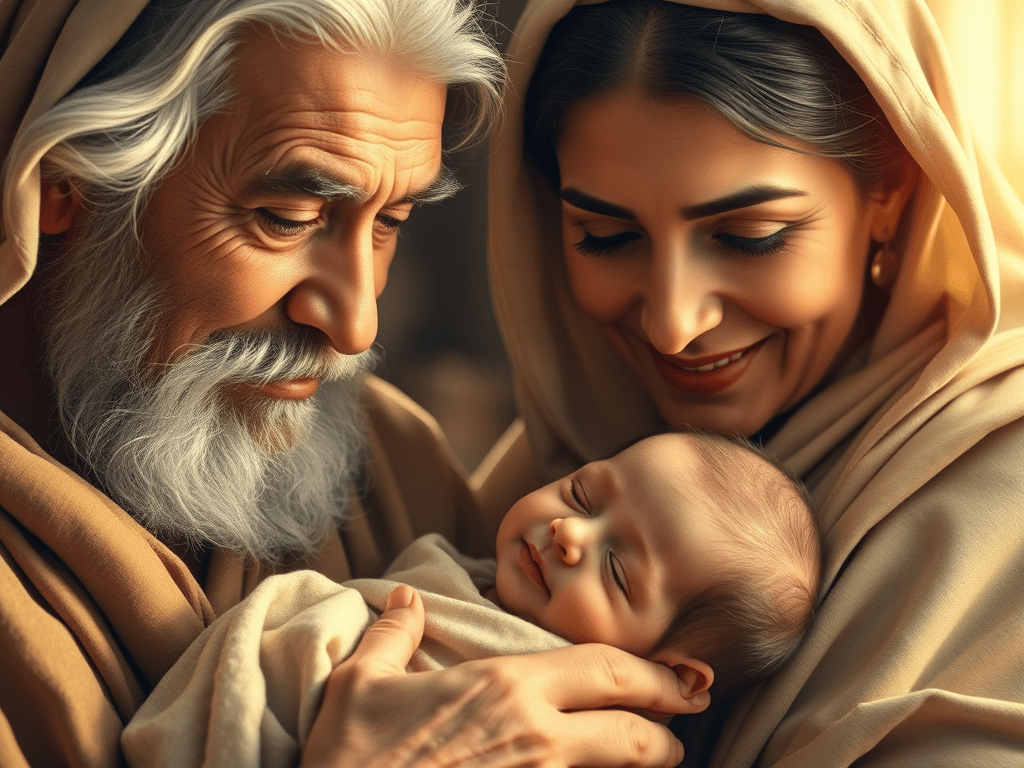
Abraham and Sarah, Parents at Last! –Image generated with A.I.

Noah hammered away for what some believe to have been one hundred years, all the time waiting, and no doubt wondering, what rain and flooding was all about.

Abraham waited 25 years for the birth of the son he was promised. –And that is assuming he did not start waiting until he was 75. Personally, I bet that by age 75 he and his wife had already waited so long they had given up on children. The two spent six or seven decades wrestling with the pain and hopelessness of barrenness. 

Moses spent forty years herding sheep in the wilderness. Can you imagine the thoughts in his head as he approached his 80th birthday, a no-account old man wandering the desert with his father-in-law’s sheep? I had all the education and languages and loyalty to rescue the Hebrews, but I failed and God banished me to waste my life in the desert

What about David? He was anointed king at about age fifteen. He quickly proved himself by killing Goliath. He became a high-ranking military officer, a gifted tactician on the battlefield–and then he waited. And waited, while Saul chased him around Israel trying to murder him. And David honored God and the king by not killing Saul, though he had several opportunities and plenty of well-meaning advisors telling him to do it. Fifteen years passed before he finally took the throne. (We condemn David for the failures that came later, but imagine the dark turn his life would have taken if he had murdered Saul when he had the chance.)

My favorite is Joseph, of course. (He is my favorite in many categories.) What a life of integrity. He was sold into slavery at 17 and spent most of the next thirteen years in prison. But he was faithful to God and God raised him to second-in-command when he was 30. 

“And God remembered Rachel, and God hearkened to her, and opened her womb. And she conceived, and bare a son. And said, ‘God hath taken away my reproach.’ And she called his name Joseph, and said, ‘the Lord shall add to me another son’” Genesis 30:22-24.

“Be patient therefore, brothers, until the coming of the Lord. See how the farmer waits for the precious fruit of the earth, being patient about it, until it receives the early and the late rains” James 5:7.

I believe God chooses different people for different kinds of struggles. One of mine is the struggle of waiting. But I remember Moses and his forty years in the desert with only sheep to talk to.

I think of Joseph who had such a special bond with his father, but spent years in a dark, rat-filled dungeon, though all he had ever done was act with integrity.

I encourage myself by remembering David and his fifteen years on the run from Saul.

And I think of Hannah, who finally had a son, Samuel, then almost immediately handed him over to be raised by Eli the priest.

And most of all, I remember the JOY: Abraham and Sarah’s JOY over the birth of Isaac, David’s JOY over the kingdom, Joseph’s JOY when he was reunited with his brothers and his father, Hannah’s JOY when God gave her a son. Moses’s JOY when God called him–though he was reluctant–and God gave the old man’s life an incredible mission and purpose. 

“The Lord is not slow in keeping His promise, as some understand slowness. Instead, He is patient…” 2 Peter 3:9.

AΩ.

* You know what verse people love on waiting? “They that wait upon the Lord will renew their strength…” Isaiah 40:31. That is a great verse but the word ‘wait’ in this context does not seem to mean wait in the sense of time passing so much as it means trusting, hoping, or depending. If you depend on the Lord, He will renew your strength.

** The title comes from the chorus of “The Waiting” by Tom Petty: 

The waiting is the hardest part

Every day you get one more yard

You take it on faith, you take it to the heart

The waiting is the hardest part.

Blessings and the Power of Words. Genesis 27:27-29.

“Ah, the smell of my son is like the smell of a field the Lord has blessed. Therefore, God give thee of the dew of heaven and the fatness of the earth, and plenty of corn and wine. May people serve thee and the nations bow down to thee. Be lord over thy brethren and let thy mother’s sons bow down to thee. Cursed be everyone that curseth thee and blessed be he that blesseth thee” Genesis 27:27-29.

Summary: May God give you food and wine and leadership over family and nations.

“May God almighty bless thee, and make thee fruitful and multiply thee, that thou mayest be a multitude of people, and give thee the blessing of Abraham, to thee, and to thy seed with thee, that thou mayest inherit the land wherein thou art a stranger, which God gave to Abraham” Genesis 28:3-4.

Summary: May God give you many descendants, plenty of land, and the blessing of Abraham.

“I am the Lord, the God of your father Abraham and the God of Isaac. I will give you and your descendants the land on which you are lying. Your descendants will be like the dust of the earth, and you will spread out to the west and to the east, to the north and to the south. All peoples on earth will be blessed through you and your offspring. I am with you and will watch over you wherever you go, and I will bring you back to this land. I will not leave you until I have done what I have promised you” Genesis 28:13-15.

Summary: I will give you more descendants than you can count, plus land and territory wherever your children may go, your descendants will be a blessing to the world, and I will be with you and bring you home one day.

We should not consider our words to have magical power. We are speaking a prayer to God, asking Him to bless our loved ones. We are not casting a spell and hoping the universe will cooperate.

AΩ.


[1] Many credit Rhonda Byrne’s book and documentary film THE SECRET with popularizing the ideas of manifestation and the Law of Attraction.

*Though the “universe” cannot listen, the universe is filled with sentient beings who can. Not only can God hear your words, but angels and demons can also hear your words. But whether they can respond to them—or would want to—is another matter.

Divorce. 1 Chronicles 8:8.

“Sons were born to Shaharaim in Moab after he had divorced his wives Hushim and Baara. By his wife Hodesh he had Jobab, Zibia, Mesha, Malkam, Jeuz, Sakia, and Mirmah. These were his sons, heads of families. By Hushim he had Abitub and Elpaal” 1 Chronicles 8:8.

“Moses permitted you to divorce your wives because your hearts were hard. But it was not this way in the beginning. I tell you that anyone who divorces his wife, except for sexual immorality, and marries another woman commits adultery” Matthew 19:8-9.

“Did not one God create us? Why do we profane the covenant of our ancestors by being unfaithful to one another? … The Lord is the witness between you and the wife of your youth. You have been unfaithful to her, though she is your partner, the wife of your marriage covenant. Has not the one God made you? You belong to him in body and spirit … So be on your guard, and do not be unfaithful to the wife of your youth. “The man who hates and divorces his wife,” says the Lord, the God of Israel, “does violence to the one he should protect,” says the Lord Almighty” Malachi 2:10-16.

Many translations put it more bluntly: “‘For I hate divorce,’ says the Lord God of Israel” Malachi 2:16.

As Bible readers, we must avoid drawing conclusions based on the fallacy known as the “Argument from Silence.”

AΩ.

Study Genealogies to Show Thyself Approved. 1 Chronicles 1:1.

“Adam, Seth, Enosh, Kenan, Mahaleel, Jered, Enoch, Methusaleh, Lamech, Noah, Shem, Ham, and Japheth. The sons of Japheth … the sons of Ham … the sons of Shem …” 1 Chronicles 1:1-17.

But why does the Bible pass such records down to us? What can these long, boring lists of difficult-to-read names teach us today? Here are seven lessons from genealogies; the first six I have discussed previously:

  1. Biblical genealogies prove that character traits can be passed down: they run in families.
  2. Genealogies indicate that in God’s eyes, the birth of a child is the birth of a lineage—not just a single person.
  3. Genealogies prove no man is an island. We are connected.
  4. Genealogies prove God loves “the little people.”
  5. Biblical genealogies defeat racism, proving that we are all the human race.
  6. Genealogies indicate that God values family trees and our ancestral heritage more than we do. (It means something or it would not be in the Bible!)
  7. Finally, memorizing Biblical genealogies provides a mental framework on which to hang additional information.

AΩ.

City Planning. Nehemiah 11:1-2.

I’ve since run across some real-life city planning problems:

How was Galveston to respond to the hurricane that wiped the city off the map in 1903? (The city built a concrete seawall and bounced back, though its port was moved to the safer waters of Houston.)

What was Detroit to do when factories closed down and workers moved away leaving miles of urban housing empty? Old neighborhoods became ghost towns, leaving the people in the suburbs to travel through miles of empty areas to reach their jobs in the city. (The city razed the empty houses, converting the land to parks and gardens.)

New York found itself filled with disease-ridden, crime-infested tenement housing which often saw ten or twelve families living in apartments designed for single families.[2] The city fought for the poor by passing laws requiring more fire escapes, more working outhouses/toilets, more space-per-person, more ventilation, more windows, periodic inspections, and in the end, a “Multiple Dwelling Law” that led to many tenements being torn down.

Finally, there is the fact that Houston (like so many of the world’s great cities) is sinking due to subsidence. My day job is part of the solution, a project to convert the city from over-use of groundwater to greater reliance on river water.

As I have noted often, the Bible is an intensely practical book.

(Unlike most religious texts, the Bible is not always poetry, and it is not always ‘spiritual.’ It is often quite practical.)

When the Israelites returned from the Babylonian captivity, they faced numerous city-planning problems.

“Now the leaders of the people settled in Jerusalem. The rest of the people cast lots to bring one out of every ten of them to live in Jerusalem, the holy city, while the remaining nine were to stay in their own towns. And the people blessed all the men that willingly offered to dwell in Jerusalem” Nehemiah 11:1-2.

“The leaders of the people settled in Jerusalem” v.1.  Being a leader means doing hard things. The early days of a new project are hard, but that’s what leaders signed up for.

‘The people blessed those who willingly offered” v.2. I think the next best thing to a leader is a VOLUNTEER. And you know who appreciates volunteers? Those who did not volunteer. But so do the leaders. Leaders value volunteers. And–

If you hope to be a leader, volunteering is one way to get there.

“The rest of the people cast lots” v.1. This third group was drafted. They may not be appreciated the way volunteers are, but they will pitch in, do the work, and reap a deserved reward. Service is appreciated, whether you volunteered or not. We appreciate your service for the kingdom.

AΩ.


[1] https://www.smithsonianmag.com/history/draining-swamp-guide-outsiders-and-career-politicians-180962448/

[2] I was reading yesterday about one tenement found with a wet cellar full of pigs, complete with a heavy load of unventilated manure. More commonly, landlords placed newly arrived immigrant families in the cellars or the tiny attics several flights up. Several of these tenements were found to contain nearly 100 children in only four apartments. In such close quarters, it is understandable that recurring epidemics spread like wildfire, wiping out large numbers living in poverty. HOW THE OTHER HALF LIVES: Studies Among the Tenements of New York, by Jacob Riis (1890).

[3] https://en.wikipedia.org/wiki/Siloam_tunnel

What if You Have No Family Tree? Nehemiah 7:61-65.

Our identity as Americans rebels at what a family tree represents.

These Hebrews lost touch with ancestors because they had NO CONTINUITY.

“These were they who came up from Tel-melah, Tel-harsha, Cherub, Addon, and Immer; but they could not show their fathers’ houses or their descendants, whether they were of Israel: the sons of Delaiah, the sons of Tobiah, the sons of Nekoda … Of the priests: the sons of Hobaiah, the sons of Hakkoz, the sons of Barzillai … These searched among  their ancestral registration, but it could not be located; therefore they were considered unclean and excluded from the priesthood. The governor said to them that they should not eat from the most holy things until a priest arose with Urim and Thummim” Nehemiah 7:61-65.[3]

But does knowing a genealogy or a family tree make any difference? Does God expect you and me to be able to recite our family trees?

Like the Hebrews without family trees, Americans have NO CONTINUITY.

The poet-pastor John Donne may have told us “No Man is an Island,” but Americans do not believe it. We are obsessed with our own independence, committed above all else to a life of passionate self-determination.

And perhaps that is the lesson here. Not everyone knows their ancestors. We have no continuity. We live in broken homes. Foster homes. Adoptions. Absent fathers. Divorces. Blended families. Job transfers. And people on the run. People off the grid. Fugitives.

And for all of the above, there is grace. GRACE. Lean-in to God’s amazing grace.

“I am reminded of your sincere faith, which first lived in your grandmother Lois and in your mother Eunice, and, I am persuaded, now lives in you also” 2 Timothy 1:5.

Like abilities and talents, even faith and spiritual gifts can be passed from one generation to the next.

Search for the good traits in your ancestors and God will use that search to reveal the good traits He placed in you.

AΩ.


[1] I can locate (but have not memorized!) ten generations of the Henderson clan, beginning with Thomas Henderson, Father of Colonel Richard Henderson. Thomas was born in 1650 and died in 1709 in the Colony of Virginia. Today I stumbled across an unexpected entry in the Courtenay line at generation ten: “Cherokee Indian Usaan,” DOB 1700.

[2] (The Bible, an Eastern text, is not nearly as individualistic, independence-oriented, or Western as many of its readers.)

[3] Ezra 2:59-62 records the same account word-for-word.

[4] Having mentioned my own family tree, I should note that I benefited from a tremendous amount of work done by many other people, including people on the internet that I do not know.

MONEY! Finance, Bankruptcy Protection, and the Economy. Nehemiah 5:1-11.

One of history’s great economic experiments took place when Canada and the United States were settled largely by the English, and Mexico and the nations of Central and South America were settled by the Spanish and the Portuguese. “Impose British rule on North America, and Spanish and Portuguese rule on South America, and see which one does better economically.”[1] Who would win the proverbial race to riches? “The early British colonies faced continual risk of starvation, while the Spanish to the south were planting tropical gardens and mining mountains of silver.”[2]

Yet, it is hardly controversial to state that the heirs of the British economy won the economic experiment. Why? A big part of the answer lies in the nature of Anglo-American law.

A nation’s economy is shaped less by its natural resources than it is by the environment the nation’s laws create around those resources.

“The north had [private] property rights, representative government, religious pluralism, and the rule of law. The south had none of these things.”[3]

When the King of Persia appointed Nehemiah the governor of Israel during a famine, the people came to Nehemiah in protest with complaints that sound a lot like today’s headlines:

“Now the men and their wives raised a great outcry against their fellow Jews. Some were saying, ‘We and our sons and daughters are numerous; in order for us to eat and stay alive, we must get grain.’ Others were saying, ‘We are mortgaging our fields, our vineyards, and our homes to get grain during the famine.’ Still others were saying, ‘We have had to borrow money to pay the king’s tax on our fields and vineyards. Although we are of the same flesh and blood as our fellow Jews and though our children are as good as theirs, yet we have to subject our sons and daughters to slavery. Some of our daughters have already been enslaved, but we are powerless, because our fields and our vineyards belong to others’” Nehemiah 5:1-5.

“If you lend money to one of my people among you who is needy, do not treat it like a business deal; charge no interest” Exodus 22:25.

“I was very angry … I told them, ‘You exact usury! … You are selling your own people … What you are doing is not right. Shouldn’t you walk in the fear of God? … I and my brothers and my men are also lending the people money and grain. But let us stop charging them interest! Give them back immediately their fields, vineyards, olive groves, and houses, and also the interest you are charging them” Nehemiah 5:6-11.

Borrowing has its place.

When a nation takes care of its poorest citizens, God will bless that nation.

“He that giveth unto the poor shall not lack” Proverbs 28:27.

God promises blessings on the nation that obeys Him:

“The Lord shall open unto thee His good treasure, the heavens to give the rain unto thy land in its season, and to bless all the work of thine hand. And thou shalt lend to many nations, and thou shalt not borrow” Deuteronomy 28:12.

“There should be no poor among you [if you obey], for the Lord will greatly bless you in the land the Lord your God is giving you as a possession to inherit” Deuteronomy 15:4.

AΩ.


[1] See Andrew Wilson’s discussion of Adam Smith’s THE WEALTH OF NATIONS, in Wilson’s book, REMAKING THE WORLD: How 1776 Created the Post-Christian West.

[2] Id.

[3] Id.

[4] The economy also benefits from a strong national defense (fear of invasion has a chilling effect on business!), the enforcement of contracts in court, the prosecution of financial crimes including fraud, burglary, and robbery, laws that encourage small businesses, laws protecting inventions and other intellectual property, a tax regime that does not overly-burden businesses or their employees, and so on. Do I over-state the case? I guess I’m enthusiastic, having taught college students the “Legal Environment of Business” for years!

*Some argue high-interest loans have their place, because they allow those who are the worst credit risk to nevertheless borrow money. Pawn shop loans (200% APR), car title loans (300% APR), and payday loans (400% APR) do charge excessive interest but are allowed because the total amount loaned is small, the collateral lost in the event of default is not that significant, and the repayment term is short enough it should not become a burden, and again–it allows a person in need to get their hands on cash during desperate times.