Words That Matter.

Words that matter are spoken, repeated, memorized, written down, stamped on signs, engraved on statues, monuments, and buildings, used as decoration—on tee shirts, bumper stickers, throw pillows, refrigerator magnets, hung in picture frames, and even stenciled on the walls of our homes.

Bible words matter most.  When I was a child, I saw decorative items made from Bible verses. Today at places like the biggest gas station in Texas, Bucee’s, I see less scripture and more wine: Working nine to wine, I’m a wineaholic, This is my wine drinking shirt….

Moses has little to say about wine. But he has advice on how to use the words that really matter:

Imprint these words of mine on your hearts and minds, bind them as a sign on your hands, and let them be a symbol on your foreheads. Teach them to your children, talking about them when you sit in your house and when you walk along the road, when you lie down and when you get up. Write them on the doorposts of your house and on your gates, so that as long as the heavens are above the earth, your days and those of your children may be many in the land the Lord swore to give to your fathers” Deuteronomy 11:18-21.

What are the verbs? 

What are we supposed to do with the WORDS THAT MATTER?  PRINT them on your heart and mind, BIND them on your hands and foreheads. TEACH them. TALK ABOUT them. WRITE them on the doors and gates. 

And these instructions come with a promise: Do these things—value the WORDS THAT MATTER—and your days will be many.

God, help us to LOVE YOUR WORDS. To think about them, study them, teach them, memorize them, talk about them, and more.  May our lives be filled up with your words.

ΑΩ

Blessed. Deuteronomy 6:12-14.

In America, we are so blessed, aren’t we? We have great food, clean water, nice homes, education, peace, friends, family, churches—what don’t we have? Is there anything wrong with being so blessed?

There is one risk. When people are blessed and life is good, they forget God. They ALWAYS forget God. It’s the same pattern throughout the Bible. It happens over and over: God blesses the people and they (or their children) fall away. It’s called the Deuteronomic principle. Yes, it is so common and predictable that it has a name. You can count on it, like the law of gravity. If we are blessed, we will fall away and forget God.

Then what will happen?

Judgment.

Some have argued that everything since 9/11/2001 has been judgment: wars, bank failures, hurricanes, floods, pandemics, economic collapse…

Check your heart. Are you seeking God daily? Are you listening and trying your best to obey? Reading the Word? Crying out to Him for His truth and His reign in your life?

Moses warned us:

When you eat and are full, and build beautiful houses to live in, and your herds and flocks grow large, and your silver and gold multiply, and everything else you have increases, be careful that your heart doesn’t become proud and you forget the Lord your God who brought you out of the Land of Egypt, out of the place of slavery. Deuteronomy 6:12-14.

Pray. Dear God, keep us humble. Forgive us when we let all our stuff, our successes and our easy, cushy life distract us from you. Help us love you, obey you, and serve you every day. Keep us humble. Never let us grow proud and lazy. Keep our hearts broken for the things that break the heart of God. We love you.

ΑΩ

What About the Old Testament?

We people of the New Testament have a weird relationship to the Old.  Do we obey it or not?  We avoid murder but approve eating shrimp and pork?  We ignore dietary laws, but honor the BIG TEN? If so, why do we shrug off adultery?  And why do we disregard the Sabbath?  

Some treat the law like that uncle from overseas with broken English who always wears black.  He never smiles and never approves—but that’s okay because Mom says ‘go ride your bikes and ignore him.’  He considers sports a prodigal waste of time. He’s not cool or savvy to any of the things the kids and their friends consider important. He’s just a grumpy old man from the old country.

What a perversion of God’s Word!  It is true that the Bible refers to the law as a “ministry of death” (2 Corinthians 3:7) and as a curse: “Christ redeemed us from the curse of the Law, having become a curse for us…” Galatians 3:13. But the law is a BEAUTIFUL thing.  Consider the size of the Old Testament.  We should not pretend two thirds of the Bible is irrelevant.

“The law became our teacher, to lead us to Christ” Galatians 3:24.  THAT is the New Testament purpose of the law—it reveals our sin and need for a Savior.  But the law also served an incredible purpose before Christ: God’s law contained principles that taught the nations how to have a good civilization, an effective legal system, a free market, and a democratic government.  The entire world is better off because of the law handed down through Moses.

When other nations hear about all these statutes, they will say, ‘This great nation is indeed a wise and understanding people.’ For what … great nation has righteous statutes and ordinances like this entire law I set before you today?” Deuteronomy 4:6-8.

Dear God, thank you for the Old Testament. Help us better understand its message. Deliver us from the view that would ignore the Old Testament out of ignorance and laziness.

ΑΩ

Bald Samson.

God called His people to be different.  Holy. Set apart.  A “peculiar people.”  The nation followed complex food laws.  They circumcised every male child.  They sacrificed animals. They never worked on Saturday.  Sometimes God’s “Peculiar People” must have felt peculiar.

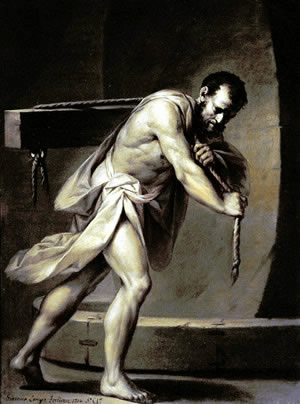
Within Israel, there were individuals whose lives were even more peculiar: Levites, priests, and Nazirites to name a few. Samson may be the only Nazirite to maintain the difficult vow his entire life.  Until he didn’t.  And what happened when he cut his hair? The Holy Spirit left the strong man and he became like other men. 

God calls Christians to be different—that is the meaning of ‘holy.’ It feels peculiar. But if we are just like everyone else, how do our lives give them hope?  Have we cleaned up our speech, our lifestyle, our media, our addictions—or are we no different than the lost?

God calls Christian institutions to be peculiar too, whether churches, schools, or parachurch organizations. If an institution stands for Christ, it should glorify Him in every aspect.  Fundraising should glorify Christ. Behavior on the football field should glorify Christ. The coach’s speech in the locker room should glorify Christ.  –And that does not mean being soft. Nothing in the Bible should give you the impression Jesus is soft.  Coaches and teachers should demand excellence.  But their personal lives should demonstrate that they have done the hard work of bringing their own behavior into conformity with Christ.

When Christian institutions make compromises that surrender their separateness—they risk becoming Bald Samson: the blessing and power of the Holy Spirit may leave them.

I urge you, brothers and sisters, in view of God’s mercy, to offer your bodies as a living sacrifice, holy and pleasing to God—this is proper worship. Do not conform to the patterns of this world, but be transformed by the renewing of your mind” Romans 12:1-2.

God, teach us to strive hard for holiness, while walking in Your Grace—and generously sharing it with others every day.

ΑΩ

Stop Praying About it!

Jesus spends hours in prayer.  He tells stories encouraging us to do the same, first of a judge who gives in because he is tired of a widow’s pleas.  In another story, a man has locked his door and gone to bed but gets up to give bread to his neighbor because the neighbor will not let him sleep. Paul sums it up: “Pray without ceasing.” (Have you ever prayed without ceasing?)

But what about Moses? The Promised Land was his life’s purpose.  At 40, failure.  At 80, the nation was delivered, but spent 40 years in the wilderness.  At 120, they are going to enter the land God promised 400 years before—but Moses does not get to go! He begs and God answers:

The Lord said to me, ‘ENOUGH!  DO NOT SPEAK TO ME AGAIN ABOUT THIS MATTER! Go to the top of Mount Pisgah and look… and you will see it with your own eyes. But you will not cross the Jordan” Deuteronomy 3: 26-27.

When I was 8 I had an operation. At 9, the pediatrician said I might need another. But I remembered the needle in my backside the morning of the surgery, and I was terrified of facing that again. (It hurt!)

I prayed constantly: all day, all night, all places. During television commercials I muttered, “please don’t let me have a hernia! Please don’t let me have a hernia!”  Same while walking to school. Climbing trees. Riding bikes. I prayed WITHOUT CEASING. 

One day I realized: I have prayed enough. If God is going to heal me, he will. If not, I will have the surgery. Either way, it’s time to stop praying about this.  Looking back, I believe that was God’s voice, though I would not have said so then. It gave me such peace.  I realized that for once, I had prayed enough.  God will do what God will do.  And I am going to trust Him—and stop thinking about it. And that is what I did.

No doctor ever mentioned it again.

God, teach us to pray without ceasing—to pray so much you have to tell us to STOP!

ΑΩ

Nation Shopping. Deut. 4:6,8-9.

A retired couple recently moved from the United States to Thailand.  Why Thailand? Because their retirement income, meager by US standards, made them wealthy in Thailand.  They bought a mansion in the country and hired both a maid and a cook.  They lived like kings and traveled constantly, convinced they had discovered the secret to retirement.

What if you could shop for a nation the way you shop for a new car—make a list of features you desire, then look for one that suits you? What would you seek?  I’d like: nice weather, beautiful views, peace, low crime rates, thriving healthcare and educational systems, and laws that protect essential human freedoms like speech, religion, press, assembly, and the right to own property.

Moses looked at the fledgling nation of Israel—with its 613 laws[1] —and predicted its future reputation:

When they hear about these statutes, they will say, ‘This great nation is indeed a wise and understanding people….’  For what great nation has righteous statutes and ordinances like this entire law I set before you today?” Deuteronomy 4:6,8-9.

Christians often speak negatively about the law.  We laugh about the 613 laws in the Old Testament, and imply that something was lacking in the law.  I’m sure Christians who read the Bible read the law less than other books. Yet Jesus said He came not to abolish the law, but to fulfill it.  And Moses said Israel’s legal system would make Israel a respected nation.  After all, this highly developed system of laws addressed everything: crime and punishment, education, marriage and family, taxes, business, employment, banking and lending, housing, lawsuits, travel, diseases, food, worship, and more.

THAT is how you build a thriving nation.  Beaches and sunsets are nice, but when God built a nation, He built it as a nation of laws.  The law is the architecture, the framework, on which the entire civilization rests: your job, your home, your food supplier, your entertainment, your family, your religion. 

God, teach us to revere and respect the study of Your laws.

ΑΩ


[1] https://www.chabad.org/library/article_cdo/aid/756399/jewish/The-613-Commandments-Mitzvot.htm

Peer Pressure.

What’s the big deal about peers? Do they have the influence everyone claims?  Yes.  Here’s why:

  1. As children look for models beyond their parents, they land on peers. We want friends.  So we try to convince our peers we are cool.  Thus, we do things to impress our peers—things we would not do otherwise.
  2. Second: young people are not born with knowledge. If you have never been to New York, for example, your knowledge of the city is based almost entirely on television.  When you finally go to New York one day, you will be amazed to discover it is not just one long Friends/Seinfeld mashup.  Similarly, children are not born with knowledge of pop culture, fashion, or what is “cool.” Most of your knowledge comes from your peers—even if your peers are idiots.  Seriously. No matter how backwards their families or how ignorant their ideas, your peers will be your TEACHERS on many subjects of fashion, culture, politics, and values. 
  3. In college, you are surrounded by peers as a fish is surrounded by water. Even if you know your peers are mostly foolish, selfish, lazy, and immoral, yet because they outnumber everyone else it is easy to think the whole world is just like them—and that doing what they do is NORMAL.

Thus, peers have an influence because 1) you want to be liked, 2) you are inexperienced and peers seem more knowledgeable about… EVERYTHING, and 3) when all you see are foolish peers, the foolish appears normal.

God knows the power of a bad influence. 

But if you don’t drive out the inhabitants of the Promised Land, those you allow to remain will become THORNS IN YOUR EYES and in your sides. They will harass you in the land, and everything I had planned to do to them, I will do to you” Numbers 33:55-56.

THORNS?  In your EYES?  Wow!  And here’s the verse that kept me paying for private school for my children: “Bad company corrupts good morals” 1 Cor. 15:33.

God, protect us from bad influences.  Make us GOOD INFLUENCES.

ΑΩ

Judgment of the Gods.

We expect God to judge people. He punishes evil people throughout the Bible.  He punished Cain by banishment. He punished the pagan world with a flood. He punished Sodom and Gomorrah with fire from heaven. He punished idolatrous, treasonous Israelites when the earth swallowed them in an earthquake.

But did you know God also judges false gods? The ten plagues of Egypt were judgments against Egypt’s idols: they worshipped the Nile, so God turned it to blood.  They worshipped frogs so he sent millions.  They worshipped the earth, so he turned the dust of the earth to gnats (some translations say fleas or lice), they worshipped flies so he sent enough to destroy everything. They worshipped livestock so God sent a plague to kill Egypt’s horses, donkeys, camels, cattle, sheep, and goats. They worshipped false gods of healing so he sent boils they could not heal.  They worshipped the sky, so he sent hail.  They worshipped crops, so he sent locusts to consume every bit of green crops not already annihilated. They worshipped the sun, so God made it dark for three days.  Finally, God judged the people themselves with the death of every first born of man and beast.

So how do we know each judgment was a judgment against a specific false god?  Because of Numbers 33:4.

The Lord executed judgment against their gods.”

The Message paraphrases it this way:

God exposed the nonsense of their gods.”

What are false gods in our world? FAME. RICHES. BEAUTIFUL POSSESSIONS.  “FOLLOWERS” or “likes” on social media. What else? 

What false gods hold appeal for you? What idols tempt you?  SUCCESS? GRADES? POPULARITY? ACHIEVEMENTS?  ATTENTION FROM ADMIRERS OR THE OPPOSITE SEX?

Dear God, bring to our attention any false gods in our lives.  Help us to draw the line and reject those temptations.  Give us the fear of the Lord, knowing that you will JUDGE our false gods.  Help us to love you most and “have no other gods” before you.

ΑΩ

Fasting is the Antidote to Indulgence. Ephesians 5:18.

Aristotle spoke of “the Golden Mean,” a balance between extremes.  He exalted courage, for example, considering it the midpoint between fear and recklessness.  He might look for a balance between spending nothing and spending too much, or between consuming entertainment and doing something creative yourself. Trouble is, for centuries Christians have taken Greek ideas and assumed they were Biblical.  Is balance Biblical?

Yes. But Aristotle’s ideas are skewed by perceptions (how do you define terms? What is a lot of this or a little of that?). 

Scriptural balance is this: God calls us to work six days, but to stop all work on day seven.  God calls us to our prayer closet alone, but also to fellowship, to “assembling together” in community. God calls us to defend the faith but to love the faithless.  God calls us to holiness but to grace in the face of failure.

One difficult subject is alcohol.  Jesus’s first recorded miracle was turning water to wine–and His last act with His disciples was eating bread and wine at the Last Supper: you cannot argue alcohol consumption is Biblically wrong in every circumstance. But we know drinking causes incredible problems—destroying lives, families, societies.  Those who indulge must find a Biblical balance.

What is the counterpoint to indulgence? Fasting.  The Bible speaks of fasting throughout both the Old and New Testaments.  Jesus did not say “IF you fast,” but “WHEN you fast….”  Jesus ASSUMED His followers would fast.

When you fast, put oil on your head and wash your face, so that it will not be obvious … you are fasting…” Matthew 6:16-18.

How many Christians who embrace the “freedom to drink” are enthusiastic about fasting?  Regular fasting in pursuit of true worship promises benefits greater than anything imparted by alcohol.  How are we to handle alcohol (and all fleshly appetites) wisely? Control it with a life of regular fasting. 

Christians who drink should be the leaders when it comes to fasting. 

If you embrace the grace that allows you to drink, do you also embrace the self-denial imparted by a life of fasting?  Regular fasting, whether for one meal, one day, or more than one day, is the spiritual discipline we need to ensure we handle alcohol wisely. If you drink often, fast often. Fasting moderates appetites, ensuring we will “Be not drunk on spirits, but filled with the Holy Spirit” Ephesians 5:18.

ΑΩ

P.S. Drinking is a nuanced issue with plenty of gray areas and room for reasonable minds to disagree. Remember the history of Prohibition in the United States: many churches and denominations took rigid positions on one side or the other–and those positions tend to persist a century after Prohibition was repealed. My conclusion is: Jesus drank wine and miraculously provided it to others. Who am I to say it is wrong? Yet dozens of Bible passages warn of the ill effects of drinking. We must do as Paul says, “let each man have his own conviction” (Romans 14:5) and “judge not” (Matthew 7:1).

Unequally Yoked.

Now there’s an archaic phrase. You’ve no doubt heard the analogy to two unmatched beasts of burden. For example, a horse and an ox cannot work together under the same yoke. They are unequal in height and gait, and cannot work together. God warns His children to “be not unequally yoked with unbelievers” 2 Corinthians 6:14. Why? Because your partnership will fail—you cannot work together.

But is this really a risk? Does it really matter? My aunt Addie told her kids “don’t date anyone you could not marry,” because there ARE people you can’t marry.

Before Moses died, God gave him one final mission. Kill the tribe of idol worshippers that seduced your Hebrew men to leave the one true God:

Avenge the children of Israel on the Midianites. Afterwards shalt thou be gathered to thy people” Numbers 31:2.

So Moses sent 12,000 men to slay ALL the men of Midian,  five kings of Midian, and ALL women who were not virgins. Why?

Because the Midianites were pagan idolaters who had already led Israel astray—and would do it again if allowed to live. So God showed little mercy. 

When it comes to the lost, we must be ruthless as well. Love them, of course. But don’t date, court, romance, or marry them. You can be kind and loving but still guard your heart. So do it. Put your walls up and don’t let yourself be tempted even for a minute—unbelievers should be off-limits for you. If they don’t share your deepest values, then you can’t work together in partnership. You are unequally yoked! So cut them off. Be as harsh as it takes. 

Remember: YOUR DATING LIFE IS NOT A MISSION FIELD.

ΑΩ