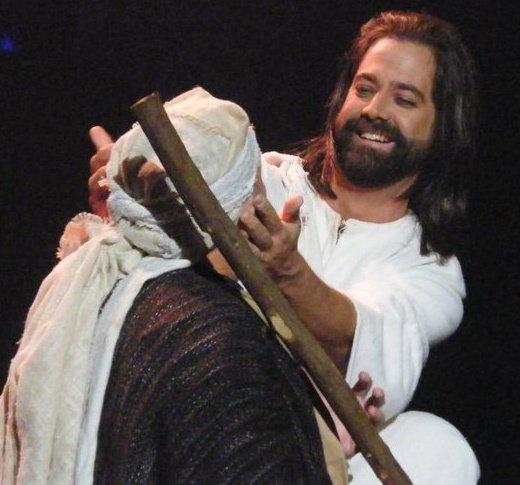
Pictured: Actors portray Jesus healing a blind man on the Sabbath.
In law school one of my colleagues asked me whether I was going to be a prosecutor.
“Because I figure, you’re definitely a law and order guy.”
I had never been called that before. As a hyperactive child, I spent most of my time on the wrong side of the law and OUT of order. As an English major, I became convinced the best stories elicit sympathy for imperfect heroes whose allegiance to rules is questionable. Jean Valjean spends nineteen years in prison because he steals a loaf of bread to feed his sister’s starving children. Where is the justice in that?
But I knew it was true: I was a law and order guy. I overcame my childish shenanigans in part by devoting myself to better choices. I went around saying things like, “Don’t do the crime if you can’t do the time.” I embraced the law long ago; today I want to embrace compassion and grace in the way law is applied.
When David was on the run from King Saul, he and the men with him were hungry. When they came across Ahimelech the priest, David asked him to give David the sacred bread—bread that the law reserved for priests alone, Leviticus 24:5-9. The priest asked David if the men had kept themselves from women. David said they had. Thus the men were ceremonially clean–but that did not make the men Levites.
“So the priest gave him hallowed bread, for there was no bread there but the shewbread that was taken from before the Lord” 1 Samuel 21:6.
In this case, David both lied to the priest, and ate bread he and his men were not supposed to eat, being from the tribe of Judah. More importantly, the priest GAVE David the bread. He could have said no. But he acted with compassion.
Would David and his men have survived without the sacred bread? Probably. Was the priest wrong to give the bread to them? I don’t know, but it would be hard to build a case against the priest considering what Jesus said about him to the Pharisees in Luke 6:1-5 and in Matthew 12.
“Have you not read what David did when he and those with him were hungry, how he entered the house of God, and they ate the sacred bread, which is not lawful for him or for those with him to eat, but only for the priests? … If you had known what this means, ‘I DESIRE MERCY AND NOT SACRIFICE,’ you would not have condemned the innocent. For the Son of Man is Lord of the Sabbath” Matthew 12:3-8.
This is a difficult passage to apply. When are we to follow rules and when can we break them? Or when SHOULD we break rules? Because we live under a new covenant, we are not bound by the law, but we live under God’s grace. “All things are lawful for me, but not all things are profitable,” 1 Corinthians 10:23.
So when is it profitable or wise to ignore a rule, a policy, a personal goal or daily commitment, whatever it is—when is it best to err on the side of compassion? I cannot answer that for you: You will need wisdom and grace to address such questions on a case-by-case basis.
But the key is this:
Let’s remember the simple fact that there ARE times when we should set the rules aside and give holy bread to unholy men. There are times when we must set aside rules and err on the side of grace, compassion, and love.
Some of the strictest rules in Israel were the rules of the Sabbath. But Jesus said it over and over: “the Son of Man is Lord of the Sabbath,” Matthew 12:8.
God, give us wisdom. Show us how to balance holiness and high expectations with mercy, grace, forgiveness, and compassion. May we love people the way YOU love people.
ΑΩ
P.S. SEVEN TIMES JESUS PERFORMED MIRACLES ON THE SABBATH:
On the Sabbath Jesus healed Simon Peter’s Mother-in-Law, Mark 1:29-31.
On the Sabbath Jesus healed a man with a withered hand, Mark 3:1-6.
On the Sabbath Jesus healed a man born blind, John 9:1-16.
On the Sabbath Jesus healed a crippled woman, Luke 13:10-17.
On the Sabbath Jesus healed a man with dropsy (water retention/edema due to congestive heart failure), Luke 14:1-6.
On the Sabbath Jesus drove out an evil spirit, Mark 1:21-28.
On the Sabbath Jesus healed a lame man by the pool of Bethesda, John 5:1-18.
–From https://teachingsofthebible.wordpress.com/2016/09/14/jesus-7-miracles-he-performed-on-the-sabbath/
See also– https://dadsdailydevotionals.com/2024/04/16/jesus-picks-a-fight-seven-times-luke-1310-17/







 Household Words: